
Privacy Policy
COMPANY WORK HEALTH AND SAFETY (WHS) POLICY
POL001 Company WHS Policy
Health Staff Australia Pty Ltd
Company Details:
Managing Director: Ross Thompson Contact number: 1300 132 595
Issued to: All staff
Date of issue: 15/03/2023
Date of review: 04/12/2025
INTRODUCTION:
The Managing Director of Health Staff Global Pty Ltd is committed to the protection of the health, safety and welfare of workers and others when in the workplace. To implement this policy, a program of activities and procedures will be set up, carried out, modified and / or updated when and where appropriate.
These programs will relate to all aspects of work health and safety including:
- Workplace Consultation;
- Work Health and Safety (WHS) information, training, and supervision;
- The risk management process and systems;
- Roles and responsibilities;
- Safe Work Method Statements (SWMS);
- Review of work methods and practice when required;
- Emergency procedures and drills;
- Providing WHS equipment, services, and facilities, including Personal Protective Equipment (PPE);
- Workplace inspections and evaluations;
- Reporting and recording of incidents and injuries;
- Injury management, rehabilitation, suitable duties, and return-to-work;
- Auditing and monitoring WHS systems, documenting outcomes for all workers to access and give feedback through WHS Committee meetings, newsletters, and other forms of in-house communications;
Reviewing management systems to ensure compliance with current legislative requirements, National Standards, Codes of Practice, Guides etc.
Any new or changed WHS requirements are disseminated to all company managers, supervisors, workers, contractors, and suppliers as appropriate.
SCOPE
This policy applies across all departments of Health Staff Global Pty Ltd and across all workplaces under this organization's control, including subcontractors and visitors to the workplace.
RESPONSIBILITIES
POL001 Company WHS Policy
FOR MANAGERS:
- Investigate reported hazards and injuries and make appropriate corrective action;
- Make sure equipment is safe and properly maintained
- Identify hazards, assess risks, and eliminate or control risks;
- Provide and implement emergency procedures;
- Provide first aid kits, facilities and trained first aid personnel;
- Make sure work areas are kept safe and free from hazards;
- Provide the necessary information, instruction, training, and supervision to all workers;
- Keep up to date with changes in WHS legislation and standards, update procedures accordingly and provide all workers with updates;
- Make sure workers compensation insurance is up to date and procedures for prompt rehabilitation is provided to workers;
- Have a return-to-work program;
- Make sure contractors comply with the current statutory safety standards;
- Provide the training and facilities for the safe handling, storage and transport of plant, equipment, and hazardous substances;
- Provide safety equipment and personal protective equipment (PPE) to comply with Australian Standards and make sure it is worn;
- Consult with workers about WHS matters so workers can contribute to decisions effecting their health, safety, and welfare;
- Keep up-to-date records of all safety issues including injuries and make sure correct procedures are followed and appropriate forms filled out;
- Review WHS management system and procedures regularly and make appropriate changes.
Workers must:
- Work in a safe manner to protect their own health and the health and safety of other persons in the workplace;
- Participate in WHS consultation, procedures, training and wear appropriate personal protective equipment and clothing provided;
- Cooperate with PCBUs in their efforts to comply with work health and safety requirements by following the safety procedures, using equipment properly, keeping work areas clean and tidy and evacuating when told;
- Report all hazards, incidents, accidents, near misses, injuries, and illness to their supervisor in a timely manner; and
- Participate in rehabilitation and return to work on suitable duties.
Subcontractors must:
- Work in a safe manner to protect their own health and safety and the health and safety of others in the workplace;
- As part of their contract, comply with work health and safety policies, procedures, and programs; and
- Observe directions on health and safety from Managers and supervisors
Suppliers must:
- Work in a safe manner to protect their own health and safety and the health and safety of others in the workplace;
- As part of their contract, comply with work health and safety policies, procedures, and programs; and
- Observe directions on health and safety from managers and supervisors
Failure to comply or observe with a direction regarding Work Health and Safety may be considered a breach of the terms of employment or contract and sufficient grounds for termination of employment or the contract.
SITE ENVIRONMENTAL POLICY
POL002
INTRODUCTION
Health Staff Global Pty Ltd has developed the following policy to create a safe and healthy workplace(s). This policy outlines the rules, responsibilities and procedures for environmental protection.
SCOPE
This policy applies across the organisation of Health Staff Global Pty Ltd and across all workplaces/worksites under this organisations control, including contractors/sub-contractors and visitors to the workplace/worksite.
RULES
- Wherever practicable employees at Health Staff Global Pty Ltd will reduce the volume of waste generated and reuse and recycle. Whenever possible new products and supplies should be reusable and/or recyclable;
- Where possible purchase responsibly, for example purchase local products to reduce transport emissions and support the local community, be aware of where the product has come from – is it causing deforestation, loss of habitat or exploiting workers in another country;
- Prevent any actions from work activities causing environmental damage by following preventative procedures
- In the event of an incident/accident follow the emergency procedures, making sure that the appropriate equipment is available for clean up and that a quick response is applied to eliminate or reduce any damage; and
- Be aware of environmental issues and safeguards, including erosion and sediment control, weed invasion, sensitive/rare vegetation and fauna, air quality, noise, waste, heritage and archaeological sites.
RESPONSIBILITIES
Managers and Supervisors must:
- Implement and review this policy;
- Consult with workers about this policy;
- Provide resources, information, training and supervision for workers to allow them to adhere to the rules and have the knowledge and resources to follow the procedures and understand their roles and responsibilities;
- Comply with statutory requirements, codes, standards and guidelines;
- Make sure all vehicles are serviced and not showing visible emissions;
- Make sure noise and air pollution are monitored and kept to the appropriate levels;
- Provide areas for chemical storage;
- Make sure all incidents are investigated and if required appropriate disciplinary action carried out.
Workers must:
- Comply with the rules of this policy and follow procedures;
- Use, store and dispose of chemicals as per the Safety Data Sheet (SDS);
- Remove waste from the workplace/worksite and place in designated receptacle/waste area;
- Report any incidents or complaints to the manager/supervisor;
- Participate in consultation and training in relation to environmental management; and
- Advise manager or supervisor of any potential breaches, sightings of rare plants or animals, fauna or archaeological or heritage items.
PROCEDURES
Responsible Behaviour
- Dispose of rubbish responsibly, either recycle or place in designated receptacle/area;
- Prevent chemicals and other foreign material from entering drains, gutters or contaminating ground soil;
Waste
- Dispose of chemicals and hazardous substances as directed on the SDS;
Discovery of Rare or Endangered Species
- Stop work;
- Notify officer or supervisor;
- If a plant is found, mark location of plants. If an animal, mark location where sighted;
- Manager/supervisor to identify/arrange identification of species;
- If confirmed significant, manager/supervisor to liaise with relevant local and state government authorities; and
- Recommence work when cleared by manager/supervisor.
Discovery of Archaeological/Heritage Item(s)
- Stop work;
- Do not further disturb the area;
- Notify manager/supervisor;
- Manager/supervisor to arrange appraisal of specimen;
- If confirmed significant, manager/supervisor to liaise with relevant local and state government authorities; and
- Recommence work when cleared by manager/supervisor.
WORKPLACE ANTI-BULLYING POLICY & ANTI-HARASSMENT POLICY
POL003
Health Staff Australia seeks to provide a work environment that is safe and enjoyable for all. Workplace bullying has a detrimental effect on Health Staff Australia and its people. It can create an unsafe working environment, result in a loss of trained and talented workers, cause the breakdown of teams and individual relationships, increase absenteeism and reduce efficiency and productivity.
People who are bullied can become distressed, anxious, withdrawn and can lose self-esteem and self-confidence. Workplace bullying is also in some circumstances against the law. For these reasons bullying will not be tolerated by Health Staff Australia.
Health Staff Australia recognises that workplace bullying may involve comments and behaviours that offend some people and not others.
Health Staff Australia accepts that individuals may react differently to certain comments and behaviour. That is why a minimum standard of behaviour is required of workers. This standard aims to be respectful of all workers.
Health Staff Australia recognises that workplace bullying can take place though a number of different methods of communication including face to face, email, text messaging and social media platforms.
As such, this Policy applies to all methods of communication through which workplace bullying can take place. This Policy applies to behaviours that occur:
• in connection with work, even if it occurs outside normal working hours;
• during work activities, for example, when dealing with clients;
• at work related events and functions, for example, at Christmas parties; and
• on social media platforms where workers interact.
This Policy applies to all workers including employees, contractors and volunteers.
In so far as this policy imposes any obligations on Health Staff Australia (ie those additional to those set out under legislation), those obligations are not contractual and do not give rise to any contractual rights. To the extent that this policy describes benefits and entitlements for employees (ie those additional to those set out under legislation), they are discretionary in nature and are also not intended to be contractual. The terms and conditions of employment that are intended to be contractual are set out in an employee’s written employment contract.
Health Staff Australia may unilaterally introduce, vary, remove or replace this policy at any time.
WHAT IS WORKPLACE BULLYING?
Workplace bullying occurs when an individual, or a group of individuals, repeatedly behaves unreasonably towards a worker, or a group of workers, and the behaviour creates a risk to health and safety.
It includes both physical and psychological abuse.
Bullying behaviours can take many different forms, from the obvious (direct) to the more subtle (indirect). The following are some examples of direct bullying:
- Sabotage: Intentionally interfering with a colleague’s work can be a form of bullying. This might include withholding important information or spreading misinformation. For example, providing handover notes that omit relevant information about the client or do not include tasks that are mandatory to be completed on shifts.
- Manipulation and Intimidation: This includes undermining someone's work, giving impossible tasks, or setting them up to fail. For instance, a manager might set excessively tight deadlines that are unrealistic, creating undue stress for employees.
- Gossip and Rumour Spreading: Spreading false information or gossip about someone can damage their reputation and self-confidence. This might involve coworkers discussing personal matters or making derogatory remarks about a colleague's abilities.
- Taking Credit for Others' Work: This involves stealing credit for someone else's ideas or contributions, which can undermine their professional standing and morale. This also signing completion of tasks that were completed by someone else.
- Publicly calling out a colleague in a public forum or shift notes. For example, highlighting work not completed on a previous shift by another employee
- Abusive, insulting or offensive language or comments. For example, using vulgar language while addressing or conversing with a staff member or colleague
- Belittling or humiliating comments; For example, quoting or making racial remarks towards or in the presence of others
- The following are some more examples of indirect bullying:
- victimisation; and
- practical jokes or initiation.
- unjustified criticism or complaints;
- deliberately excluding someone from work-related activities;
- withholding information that is vital for effective work performance;
- setting unreasonable timelines or constantly changing deadlines;
- setting tasks that are unreasonably below or beyond a person’s skill level;
- denying access to information, supervision, consultation or resources to the detriment of the worker;
- spreading misinformation or malicious rumours; and
- changing work arrangements such as rosters and leave to deliberately inconvenience a particular worker or workers.
- The above examples are not an exhaustive list of bullying behaviours. They are indicative of the type of behaviours that may constitute bullying and are therefore unacceptable to Health Staff Australia. If you are unsure whether behaviour not provided on this list constitutes bullying, you should contact your direct supervisor in the first instance.
WHAT IS NOT WORKPLACE BULLYING?
Reasonable management action taken by managers or supervisors to direct and control the way work is carried out is not considered to be workplace bullying, if the action is taken in a reasonable and lawful way. The following are some examples of reasonable management action:
• realistic and achievable performance goals, standards and deadlines;
• fair and appropriate rostering and allocation of working hours;
• transferring a worker to another area or role for operational reasons;
• deciding not to select a worker for a promotion where a fair and transparent process is followed;
• informing a worker about unsatisfactory work performance in an honest, fair and constructive
• informing a worker about unreasonable behaviour in an objective and confidential way;
• implementing organisational changes or restructuring; and
• taking disciplinary action, including suspension or terminating employment where appropriate or justified in the circumstances.
OTHER UNACCEPTABLE CONDUCT
Single incidents of unreasonable behaviour (such as harassment, violence or threatening behaviour) can also present a risk to health and safety and will not be tolerated. Harassment is considered to be any form of behaviour that is:
• unwanted;
• offends, humiliates or intimidates; or
• creates a hostile environment.
Where such conduct occurs towards a person due to a particular characteristic of that person (such as when based on sex, sexual orientation, pregnancy, marital status, age, disability, ethnicity or race, etc) this may be unlawful under discrimination and equal opportunity law, even if it is limited to a single incident. For example, sexual harassment is unlawful even where it is not repeated conduct.
All workers are required to comply with Health Staff Australia’s Equal Opportunity and Anti-Discrimination Policy which provides further guidance in this area.
Health Staff Australia will also not tolerate any form of workplace violence.
Workplace violence is considered to be any incident where a person is physically attacked or threatened in the workplace, whether this is directed to a co-worker, subcontractor, client, customer or visitor. It includes (but is not limited to):
• Any type of direct physical contact such as punching, pushing, tripping, spitting, blocking of someone’s way, etc.;
• any form of unwanted physical contact.
MANAGERS’ AND SUPERVISORS’ ROLES
Managers and supervisors have an important role to play in terms of fostering a culture that does not tolerate or encourage harassment, bullying or workplace violence and should ensure that they do not engage in any conduct of this nature themselves.
Managers and supervisors should also ensure that workers understand this Policy and consequences of non-compliance. When managers and supervisors observe harassment, bullying or workplace violence occurring, they should take steps to prevent this conduct from continuing and warn the person or people involved of the consequences if the behaviour continues (including disciplinary measures up to and including termination of employment). Managers and supervisors must also treat all complaints raised by workers in accordance with Health Staff Australia’s Complaint Handling Policy.
WORKERS’ ROLE
Health Staff Australia expects workers:
• not to engage in harassment, bullying or workplace violence;
• not to aid, abet or encourage others to engage in harassment, bullying or workplace violence;
• to behave in a responsible and professional manner;
• treat others in the workplace with courtesy and respect;
• listen and respond appropriately to the views and concerns of others; and
• to be fair and honest in their dealings with others.
ARE YOU EXPERIENCING BULLYING, HARASSMENT OR BEING SUBJECT TO VIOLENCE?
Complaints of bullying, harassment and workplace violence will be taken seriously and will be handled in accordance with the Health Staff Australia’s Grievance Handling Policy. If you make a complaint of workplace bullying, harassment or violence it will be taken seriously and will be dealt with sympathetically and in a confidential manner (except where Health Staff Australia deems it is necessary to disclose information in order to properly deal with the complaint). You will not be victimised or treated unfairly for making a complaint. If the claim is found to be substantiated, Health Staff Australia will act in accordance with its Disciplinary & Termination Policy. Please note that any worker found to have fabricated a complaint may be subject to disciplinary action under the Disciplinary & Termination Policy, up to and including termination of employment.
OTHER MEASURES
Health Staff Australia also recognises the need for open communication in the workplace. Health Staff Australia may implement what training it considers necessary in relation to behavioural standards and where appropriate will hold meetings to address standards, expectations and any issues. The frequency, dates and form of this training and meetings will be determined by management of Health Staff Australia.
MORE INFORMATION
If you need any more information about workplace bullying, harassment violence please see your manager.
OTHER POLICIES
Employees are encouraged to read this policy in conjunction with other relevant Health Staff Australia policies, including:
• Code of Conduct
• Telephone, Mobile & Internet Policy
• Social Media Policy
• Equal Employment Opportunity and Anti-Discrimination Policy
• Staff Grievance Policy
Attendance or absenteeism policy
POL004
1. Attendance or absenteeism policy
1.1 Application - who does it apply to?
The policy should apply to all employees. The policy must define what the employer means by absenteeism.
1.2 Definition
Absenteeism is any instance where an employee is absent from the workplace or from his workstation, without authority.
This therefore includes total absence from the workplace; it includes extended tea breaks, extended lunch breaks, extended smoke breaks, and any other absence from the workstation without authority.
Absenteeism includes late arrivals, and failure to arrive at work for previously agreed overtime.
Absence after permission has been refused is extremely serious - as well as failure of the employee to pitch for overtime work after previously agreed to work it. Such instances will require a formal disciplinary hearing.
1.3 The reason for the policy
State that the reason for the policy is to control those employees who take leave of absence without authority or without good reason. State that this includes taking sick leave when the employee is not sick
You can explain that unauthorized absenteeism costs the company money in hard cash - because the employee is being paid to do his/her work
That type of expense adversely affects the company's profitability, and thus rolls down to employee salary increases and bonuses.
1.4 Your procedure
State in the policy what your procedure will be.
For example:
Counselling interviews will be held with the employee when he returns to work, to establish the reason for absenteeism, whether the reason is acceptable or valid, and if not acceptable or valid, to decide on what disciplinary action is to be taken.
It should be mentioned that any such disciplinary action could lead to dismissal.
An especially crucial point to be covered in unauthorized absenteeism is to establish from the employee because he did not obtain authority before taking the time off.
Another reason is to establish from the employee why he did not telephone the employer on the first day of absence to uniformly employer that he would be absent, and to inform the employer of the reason for the absence and the expected date of return to work.
Minutes must be kept of these counselling sessions - and it should be signed by management and the employee concerned, and a copy thereof handed to the employee. If you wish, you can even draw up a standard form, containing subheadings under which the required information can be written in.
In that way, you do not have to have minutes typed - the minutes are ready as soon as the meeting is ended. It only remains for both parties to sign, and to photostat a copy for the employee.
This interview will also identify the reason for the absence and the category into which it falls: unpaid leave, paid sick leave, paid annual leave, unpaid sick leave or whatever.
That information in turn will enable HR to properly categorize the days absent into paid or unpaid days, and into the proper category, which in turn will enable HR to calculate the cost of absenteeism quickly and efficiently in cash terms for any employee.
Such information is vital to the employer and especially in reviewing an employee's performance, in giving him a performance rating, in deciding on the percentage of an annual increase or performance increase, in deciding on the percentage of any performance bonus to be awarded or not awarded, and in deciding on the all-important issue of the 13th cheque.
Thus, proper attendance, absenteeism, and management are vital in any organization.
If the employer chooses not to manage these most important aspects of his organization, then he deserves everything that he gets!
1.5 Example: absenteeism policy
The employees’ normal working hours are stipulated in the employees Contract of Employment.
The employee may be requested to work overtime as required, by prior arrangement.
Remuneration for overtime worked shall be as arranged and agreed upon with management before it is worked.
Employees must notify their immediate superior if any overtime is required, to enable proper records to be kept.
The hours of work as stated in the employee’s Employment Contract constitute a contractual agreement between employer and employee. Any violation of that agreement constitutes breach of contract – which is a serious matter.
Employees are expected to not stay away from work without a valid and acceptable reason, and employees should not be absent without prior authority where possible.
Should an employee find that they are unable to attend work on any particular day, and no prior authority has been obtained, then the employee is required to notify his/her immediate superior or other authorized person, before 9 am on the day in question, of the reason for the absence and the estimated date of return to work.
Employees who fail to act as above shall be charged with misconduct and disciplinary action shall be taken.
The same requirement applies to late arrivals. If the employee concludes that they are likely to arrive at work late, for whatever reason, the employee is required to notify the immediate superior or other authorized person of the reason for the lateness, and the expected time of arrival at work.
If nothing else, it is only courtesy to do so – which enables the employer to make whatever arrangements are necessary to ensure continuity of business.
Habitual late-coming, or repeated instances of unjustified or unauthorized absenteeism, will be treated as misconduct and disciplinary action will be taken, which may lead to dismissal.
Employees who have been absent for five days or longer without notifying the employer shall be deemed to have deserted and will be dismissed.
Privacy Policy
POL005
Our Privacy Policy is a commitment to the Privacy Act 1988 (“Privacy Act”) and the 13 Australian Privacy Principles (“APP’s”) in the Act which regulates the collection, use and/or disclosure of personal information about individuals (including but not limited to candidates, clients, suppliers, refers, contractors and employees).
This commitment is expressed as follows:
- Collection of Personal Information
We will, by fair and lawful means, only collect sufficient personal and sensitive information which is considered necessary to carry out our business activities and functions. When we collect personal information about you through third parties, we will manage such information in accordance with the APP’s.
What is personal information?
Personal information means information or an opinion (including information or an opinion forming part of a database), whether true or not, and whether recorded in a material form or not, about an individual whose identity is apparent or can be ascertained, from the information or opinion.
The following personal information will be collected from you although is not limited to:
- Contact information (e.g., full name, address, contact phone number(s), email address, date of birth.);
- Information about your education, work experience, qualifications, and skills.
- Driver’s license and any other applicable licenses and certificates.
- Information about your work rights and eligibility to work in Australia; and
- Your tax file number, banking details and ant information necessary to facilitate payment of wages;
- Criminal record or working with vulnerable persons record;
- Health or disability (at any time);
- Sexual preferences or practices;
- Expressed wishes about the future provision of health or support services (participants and residents);
- Racial or ethnic origin;
- Political opinion;
- Sensitive information can, in most cases, only be disclosed with your consent.
How your information will be collected:
Usually, personal information is collected from you directly during an interview or registration process. Personal information may also be collected by phone or when you fill out an application or service agreement form online or in hard copy or when you send us your details via email, fax or in the mail.
Specific ways that Health Staff Global Pty Ltd may collect your information include:
- When you make an inquiry about using our services & supports either directly or through our website;
- Information you have authorised a third party to pass onto us;
- Directly when you apply for a position with Health Staff Global Pty Ltd or its related Entities via you resume/application;
- When we receive any reference about you;
- When you are named in feedback (whether negative or positive);
- When we receive a complaint from or about you;
- When we receive information about an insurance investigation, from the NDIS, litigation, registration or professional disciplinary matter, criminal matter, inquest, worker’s compensation claims or inquiry in which you are involved;
- Or you provide us with any additional information about you.
Health Staff Global Pty Ltd
May also collect personal information in the normal course of business. This information is collected through meetings, phone calls, letters, faxes, e-mails, as well as agreements, documents, and dealings.
You have the right to withhold your name or to use a pseudonym in place of your real name to identify yourself although where it is impracticable for Health Staff Global Pty Ltd to deal with individuals who have not identified themselves, such as for the purchase of goods or services by means of a credit card, you will need to supply your real name.
What information do we collect hold and use?
- Information provided for support services;
- Information provided within applications for employment within Health Staff Global Pty Ltd and its related Entities;
- Responses to questions or queries that Health Staff Global Pty Ltd;
- Information required to improve the services and information we provide.
Collection from external sources:
Personal and sensitive information may also be collected about you from third parties in which case this information will be managed in accordance with the APP’s. Such information may include, but is not limited to:
- Information about your health, medical history, or specific condition.
- Criminal record history.
- Information regarding your work performance from references.
- Membership of a professional or trade association or membership of a trade union; and
- Other information that may be relevant to circumstances
2. Use and Disclosure
The company may use and/or disclose your personal information for any of the purposes for which it was collected or where it is under a legal duty to do so. Any disclosures required by law will only be made after consultation with the Privacy Officer and will be appropriately recorded.
Your personal and sensitive information may be used in connection with:
- Your actual or work placement with one of our clients.
- Performance appraisals, training initiatives and selection purposes.
- Any test or assessment (including medical tests and assessments) that you might be required to undergo.
- Any workplace rehabilitation.
- Our management of any business risks, investigations, resolution and defence of complaints and legal claims, compliance with court order and other legal obligations and regulatory requirements.
- Any insurance claim or proposal that requires disclosure of your personal or sensitive information.
- To advise you of opportunities you may be interested in.
- Customer service management.
- Support service management.
- Training and events.
- Surveys and general research; or
- Business relationship management
Your personal and sensitive information may be disclosed to:
- Potential and actual clients to whom we provide services to;
- Referees or reference seekers.
- Our insurers.
- A Workers Compensation body; or
- Any person with a lawful entitlement to obtain the information.
Unsolicited personal information
Personal information that we receive and was not directly solicited by us, will be retained, and used in accordance with the Policy if we determine that the personal information obtained could have been collected in line with the APPs or the information is contained within a commonwealth record. If this is not the case active steps will be taken to destroy the information to ensure it is de-identified.
3. How will your information be used and disclosed?
We do not sell, rent, or trade the information that we collect. Health Staff Global Pty Ltd may use and disclose your personal information for the primary purpose for which it is collected or for the following purposes:
We will only disclose certain information if the disclosure is required or authorised by law or the disclosure is necessary for the business of Health Staff Global Pty Ltd.
You consent to Health Staff Global Pty Ltd, its contractors, employees, agents and third-party service providers using and disclosing your personal information for the primary purpose for which it was collected or for:
- Verifying your identity;
- Your actual or work placement or service placement;
- Our management of any complaint, feedback or investigation or inquiry in which you are involved;
- Any insurance claim or proposal that requires disclosure of your personal or sensitive information;
- To support the needs of the service user;
- Providing goods and services to you;
- Asking for your participation in our marketing or other campaigns;
- Improving our website and any goods or services provided by Health Staff Global Pty Ltd, including contacting you about those improvements and asking you to participate in surveys;
- Direct marketing by, or on behalf of Health Staff Global Pty Ltd, including in relating to events, conferences, and promotional activities (including by direct mail, telemarketing, email, SMS, and MMS messages);
- Providing information on our compliance with applicable laws and accreditation bodies and;
- Any other matters necessary to facilitate the primary purpose for which the personal information was collected.
4. Data Quality
We will take reasonable steps to ensure that any personal information that we collect is accurate, complete, and up to date.
Based on verifiable date, we undertake to correct personal information so that is accurate, complete and up to date. In the case of disagreement, we will on request by the person concerned attach their statement claiming that the information is not accurate, with the personal information in question. We will always provide (and record) reasons for denial of access of refusal to correct personal information.
5. Data Security
We will take reasonable steps to protect the personal information we hold from misuse and less, unauthorized access, modification, or disclosure. Further we will take reasonable steps to destroy or permanently de-identify personal information which we no longer require to carry out our business activities and functions.
6. Openness
We will make this Policy available to any person who asks for it. On request we will let any person know what sort of personal information we hold for that person for what purpose and how we will collect, hold, ld., use a and close that information.
7. Access to personal Information
You may request access to personal information held in relations to you by putting the request in writing and sending it to the Privacy Officer. We will respond to are request within a reasonable period, and a charge may apply for giving access to the personal information.
In certain circumstances we may refuse to grant you access to the requested personal information. In such situations we will give you written notice that sets out:
- The reasons for the refusal; and
The mechanisms available to you to make a complaint.
How can you gain access to your information to correct it if it's wrong?
Subject to some exceptions which are set out in APP12 and APP13, you have the right to see and have a copy of personal and sensitive information about you that we hold.
We will use our reasonable endeavours to ensure that:
- Your personal information is accurate, complete, and up to date and relevant for the purpose for which it was collected;
- Your personal information is protected from misuse, loss and from unauthorised access, modification, or disclosure, and;
- Your personal information that is no longer needed for any authorised purpose is destroyed, archived or permanently de-identified where it is legal and reasonable to do so.
If you can establish that personal or sensitive information that we hold about you is not accurate, complete, or up to date, we will take reasonable steps to correct it so that it is accurate, complete, and up to date. We ask that all corrections are notified to us, in writing to (EMAIL) – Privacy Compliance Officer.
If we are unable to agree that personal or sensitive information what we hold about is accurate, complete, and up to date, you may ask us to place with the information a statement by you that claims that information is not accurate, complete, and up to date.
If you wish to exercise your rights of access and correction, please refer to the section below: “How to contact us”.
In some cases, we may impose a moderate charge for providing access to personal or sensitive information, where the request creates a cost burden to Health Staff Global Pty Ltd. We will not charge you simply because you lodge a request for access.
8. Anonymity
Wherever it is lawful and practicable to do so, persons have the option of not identifying themselves, or using a pseudonym, when entering transaction with us.
9.Direct Marketing
We may use and disclose your personal information to inform you of products and services that may be of interest to you. In the event you do not wish to receive such communications, you can opt-out by contacting us via the contact details set out below or through any opt-out mechanism contained in a marketing communication to you.
10. Transborder Data Flows
We will only transfer personal information to another party in another country where it will be for the benefit of that person. We will always endeavour to obtain the consent of the person concerned and will take responsible steps to ensure that the information will not be held, used, or disclosed by the recipient inconsistently with the National Privacy Principles.
11.Privacy Issues for Resolution
Any requests for personal information we may hold, or any comment, clarifications and/or complaints should be forwarded in writing to us.
You can also obtain further information from the Privacy Commissioner’s web site, http://www.privacy.gov.au/
How to Contact Us:
Health Staff Global Pty Ltd
Privacy Compliance Officer
Employment equity policy
POL006
1.1 Scope
The employment Equity applies to all permanent and temporary employees and job applicants.
1.2. Purpose of the policy
- The purpose of this policy is to provide the guiding principles, framework and basic strategies for the development and implementation of the company’s equity program.
- To identify and eliminate all barriers and policies including unfair discrimination.
- To serve as a basis for the drafting, completion, and continued review of the company’s employment equity plan.
- Through the implementation of Employment Equity and affirmative action programs, the company will create an environment of sustainable diversity to achieve broad representation of the South African people.
1.3.Policy implementation and principles
Equity is an essential and integral component of the future of the business.
To achieve the objective of creating an equitable work environment for all personnel, the policy must be interpreted and implemented with the following principles –fairness; a culture of respect for human dignity, sensitivity, and a sense of belonging; empowerment; transparency; accountability, consistency, communication, and consultation. Every employee contributes to the success of the equity initiative by the company. Each employee should contribute to an environment that is welcoming and supportive to new employees.
Nobody should be unfairly discriminated against based on race, gender, religion, sexual orientation, ethnic status, language, religion, conscience, belief, political opinion, culture, and HIV status. Everyone should take responsibility, commitment, and accountability to ensure the success of this initiative. Gender equity is important, and no form of sexual harassment will be tolerated affirmative action form part of the broader objective of training and developing all employees in the company to fulfil their potential.
1.4 Structures for implementation
- Employment Equity Committee
- Assignment of responsibility to senior management
- Functional Heads and Senior Managers
- Line Managers
- Humana resources Managers
- Human Resources Division
1.5 Reporting employment equity
Designated employers have a duty to report on their progress in achieving equity in their workplace in terms of the Employment Equity Act, no 55 of 1998. The Act is divided into two main parts, the first dealing with unfair discrimination and the second with affirmative action. All employers must comply with the part dealing with unfair discrimination; however, only designated employers must comply with the affirmative action part. A designated employer is defined as a person with 50 or more employees, a person with fewer than 50 employees but who has an annual turnover equal or higher than the turnover published in schedule 4, municipalities, organs of state and employers bound by collective agreements to comply with the act. Excluded are the National Defense force, Intelligence Agency, and Secret services.
Designated employees who can benefit from affirmative action measures are Black people (a generic term for Africans, Colored's, Indians, and Chinese), women and people with disabilities.
Section 5 of the Act places a positive obligation on every employer to take steps to promote equal opportunities in the workplace by eliminating unfair discrimination in any policy, procedure, or practice. Employers must therefore go through a consultation and analysis process whereby it investigates its policies, procedures, and practices in the workplace to seek discriminatory practices. It must also analyze its profile to determine to what extend designated employees are underrepresented in its workplace. This entails an investigation of its documents, practices and its employment environment, consulting with employees or unions to obtain participation and input and educating employees on their right to equity and equality in the workplace.
Section 13 determines that once an employer has consulted with employees and conducted an analysis into its policies, procedures and practices and has compiled its profile, then the designated employer must prepare an employment equity plan and report on its progress to the Department of Labour by 1 October. Small employers are defined as employers with less than 150 employees and must report for the first time within a year of becoming a designated employer and thereafter, every second year, every year ending with an even number. All small employers must therefore report this year, using Form EEA2 in terms of regulation 32392 of 14 July 2009. Big employers (with more than 150 employees) must report for the first time within six months after becoming a designated employer and thereafter they must report every year.
An employment equity plan sets out the sequential process followed between the current workplace profile, the barriers identified in achieving equity, the affirmative action measures to eliminate those barriers and the goal the employer plans to achieve at the end of the planning period. If the employer conducted a proper analysis, it would know which barriers exist in its organization and it will have identified the measures it wants to implement to eliminate those barriers for it to achieve its goals.
The plan can run between one and five years and must clearly set out the numerical goals to be achieved at the end of the period.
1.6 Preamble of employment equity
Chapter 2 of the Bill of Rights, as contained in the Constitution of South Africa, enshrines the rights of all people in South Africa and affirms the democratic values of human dignity, equality, and freedom. Section 9 of the Bill of Rights deals with equality. In terms of Section 9(1) everyone is equal before the law and has the right to equal protection and benefit of the law. Equality includes the full and equal enjoyment of all rights and freedoms and promotes the achievement of equality. It provides for legislative and other measures designed to protect or advance persons or categories of persons disadvantaged by unfair discrimination. Therefore, people who have been previously disadvantaged by unfair discrimination have a constitutional right to be treated equally and fairly.
Furthermore, Section 9 determines that no person may unfairly discriminate, directly or indirectly, against anyone on one or more grounds, including race, gender, sex, pregnancy, marital status, ethnic or social origin, color, sexual orientation, age, disability, religion, conscience, belief, culture, language, and birth. Discrimination on one or more of these grounds is unfair, unless it is established that the discrimination is fair. After these sections of the Constitutions being enacted, the legislature enacted the Employment Equity Act, No 55 of 1998 (the Act), the Promotion of Equality and Prevention of Unfair Discrimination Act, No 4 of 2000 as well as the Broad-Based Black Economic Empowerment Act, No 53 of 2003.
The Employment Equity Act deals with measures to achieve equality and equity in the employment environment, together with matters incidental thereto. The Act recognizes that, because of apartheid and other discriminatory laws and practices, there are disparities in employment, occupation, and income, within the national labor market. It further recognizes that those disparities created pronounced disadvantages for certain categories of people and that those disadvantages cannot be redressed simply by repealing discriminatory laws.
Therefore, the Act aims at promoting the constitutional rights of equality by eliminating unfair discrimination and ensuring the implementation of employment equity to redress the effects of discrimination. The aim is to achieve a diverse workforce broadly representative of our people, which in turn will promote economic development and efficiency in the workplace and give effect to the obligations of the Republic as a member of the International Labour Organization.
The Act is therefore mainly divided into two main sections, one dealing with affirmative action, and the other with unfair discrimination, within a working environment. Various codes of good practice have been published to help employers and employees interpret the Act.
1.7 Prohibition of unfair discrimination
Section 5 of Chapter 2 of the Act places an obligation on every employer to take steps to promote equal opportunity in the workplace by eliminating unfair discrimination in any employment policy or practice.
“Employment Policy or Practice” is defined to include, but not limited to, procurement procedures, advertising and selection criteria, appointment and appointment processes, job classification and grading, remuneration, employment benefits and terms and conditions of employment, job assignments, the working environment and facilities, training and development, performance and evaluation systems, promotion, transfer, demotion, and disciplinary measures other than dismissal and dismissal.
The discrimination clause of the Act, section 6, prohibits unfair discrimination in that no person may unfairly discriminate directly or indirectly against an employee in any employment policy or practice on one or more grounds, including race, gender, sex, pregnancy, marital status, family responsibility, ethnic or social origin, color, sexual orientation, age, disability, religion, HIV status, conscience, belief, political opinion, culture, language and birth.
QUALITY MANAGEMENT SYSTEM POLICY
POL007
Introduction
The Quality Policy outlines the scope of the management system. It has been developed to establish Health Staff Global Pty Ltd commitment to quality, establish key objectives for the business and ensure client satisfaction.
OBJECTIVES
The Health Staff Global Pty Ltd Quality Management System (AQMS) objectives are:
- Consistently provide services that meet customer’s needs;
- Consistently provide services that meet statutory and regulatory requirements;
- Enhance customer satisfaction;
- Ensure Continuous improvement; and
Provide assurance of conformity with customer, statutory and regulatory requirements
Scope
The scope of the AQMS applies to all operational activities and employees of the Health Staff Global Pty Ltd
Content
The QMS is based on the following Standards:
- AS/NZS ISO9004: 2009 Managing for Sustained Success Standard;
- AS/NZS ISO9001:2015 Quality Management Systems Standard;
- AS/NZS ISO31000: 2009 Risk Management Principles and Guidelines;
- National Standards for Disability Services – Department of Social Services; and
National Mental Health Service Standards – Department of Health.
The AQMS aims to combine the elements of each of these complementary systems to achieve sustained success for the Health Staff Global.
Sustained success is defined as the ability to meet the needs and expectations of our customers and stakeholders over the long term and in a balanced way. The Executive Management Team (EMT) are committed to achieving independent third-party certification against the standards to ensure compliance and facilitate continuous improvement of the AQMS.
Quality Principles
The AQMS is built on 8 key principles which are based on the ISO9000 Quality Management principles and the Australian Business Excellence Framework.
- Principle 1 – Customer focus
- Principle 2 – Leadership
- Principle 3 – Involvement of people
- Principle 4 – Process approach
- Principle 5 – System approach to management
- Principle 6 – Continual improvement
- Principle 7 – Factual approach to decision making
- Principle 8 – Mutually beneficial supplier relationships
All management decisions and allocation of resources are based on these principles.
Resources are assigned to plan, implement, monitor, measure, analyse and continuously improve the AQMS in accordance with the AS/NZS ISO9001:2015 Quality Management Systems Standard.
The Health Staff Global Quality Management System (AQMS) objectives are incorporated into the Health Staff Global Balanced Scorecard to embed them throughout the organization and are reviewed annually to ensure continued suitability.
Procedures
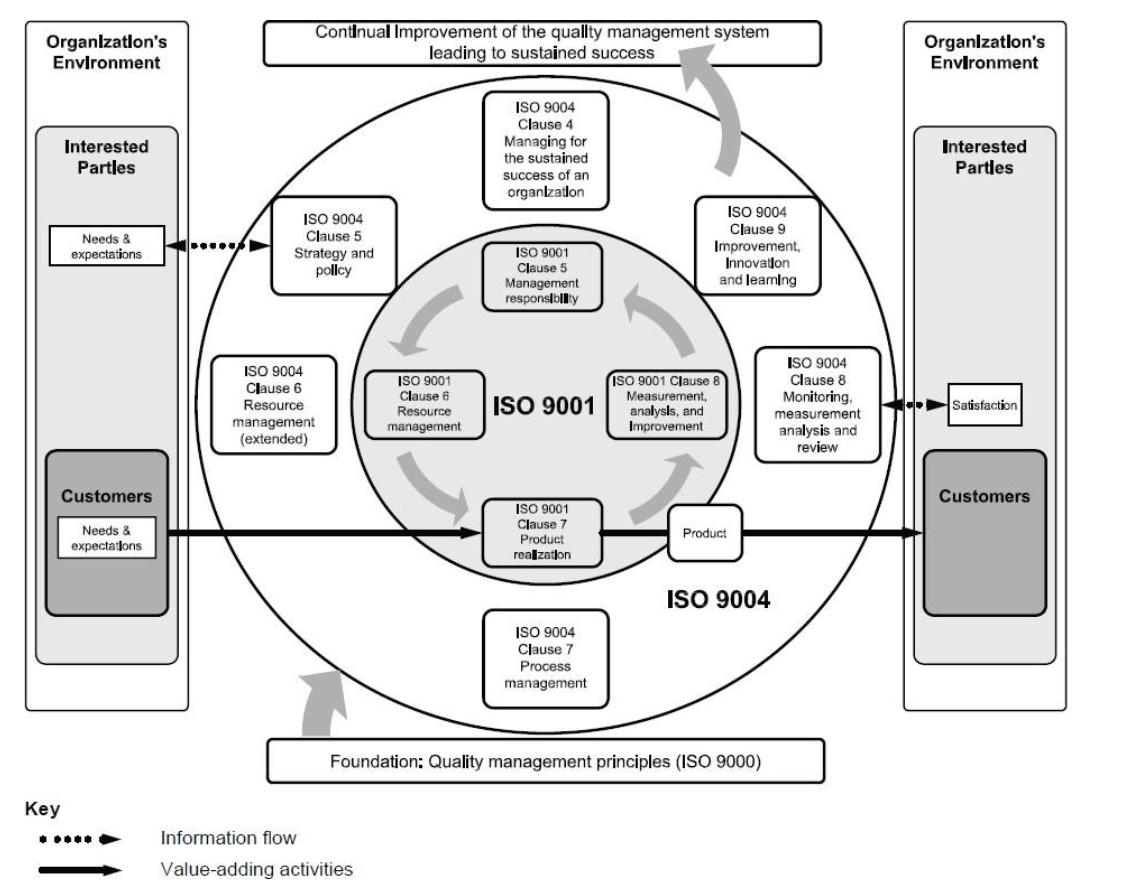
The AQMS is graphically displayed in
Figure 1: Health Staff Global Quality Management System.
Inputs
Inputs to the system include:
- Environmental scans to identify opportunities and threats;
- Feedback from customers and stakeholders regarding their needs and expectations and satisfaction with the services;
- Service process and performance data from internal audits and process monitoring.
Processes
The essential processes for the effective implementation and continuous improvement of the AQMS are illustrated below.
FINANCE PROCESS
Outputs
The outputs of the QMS are:
- Continuous improvement in the system leading to sustained success;
- Consistently providing services that meet customer’s needs;
- Consistently providing services that meet statutory and regulatory requirements;
- Enhancing customer satisfaction; and
- Providing assurance of conformity with customer, statutory and regulatory requirements.
RELATED LEGISLATION AND REGULATIONS
- ISO9000:2005, Quality Management Systems – Fundamentals and Vocabulary
- AS/NZS ISO9001:2015 Quality Management Systems Standard
- AS/NZS ISO9004:2009 Managing for Sustained Success
- AS/NZS ISO31000: 2009 Risk Management Principles and Guidelines
- National Standards for Disability Services – Department of Social Services
- National Mental Health Service Standards – Department of Health
RELATED INTERNAL DOCUMENTS
- Quality Manual
- Standard Operating Processes – Service Delivery
- Standard Operating Processes – Finance Management
- Standard Operating Processes – Product Realisation
- Standard Operating Processes – Management Review
- Standard Operating Processes – Information Management
- Standard Operating Processes – Marketing Management
- Standard Operating Processes – Human Resources Management
OUTPUTS
The essential processes for the effective implementation and continuous improvement of the AQMS are illustrated below.
INDUCTION POLICY AND CHECKLIST
POL008
1 General
Health Staff Global Pty Ltd believes that all new employees MUST be given timely induction training. This training is regarded as a vital part of staff recruitment and integration into the working environment. This policy associated procedures and guidelines define the Company’s commitment to ensure that all staff are supported during the period of induction, to the benefit of the employee and Company alike.
2 Aim
It is the aim of Health Staff Global Pty Ltd to ensure that staff induction is dealt with in an organised and consistent manner, to enable staff to be introduced into a new post and working environment quickly, so that they can contribute effectively as soon as possible. This induction policy associated procedures and guidelines aim to set out general steps for managers and staff to follow during the induction process. It is expected that all managers and staff will adhere to this policy.
Health Staff Global Pty Ltd expects that the implementation of good induction practice by managers/supervisors will:
- Enable new employees to settle into Health Staff Global Pty Ltd quickly and become productive and efficient members of staff within a short period of time.
- Ensure that new entrants are highly motivated, and that this motivation is reinforced.
- Assist in reducing staff turnover, lateness, absenteeism, and poor performance generally.
- Assist in developing a management style where the emphasis is on leadership.
- Ensure that employees operate in a safe working environment.
- Will reduce costs associated with repeated recruitment, training, and lost production.
3 The Company's Commitment
Health Staff Global Pty Ltd , Human Resources Department / Head Office will:
- Issue guidelines to familiarise managers and staff with the induction process.
- Maintain and update the Induction Policy.
- Provide a checklist for managers and staff to follow during the induction period.
- Ensure there is effective monitoring of the induction process particularly in the first three months.
- Deal with any problems promptly to provide an efficient service for both managers and staff.
- Review all policy, procedure, and guideline documents on a regular basis.
- Provide relevant formal training courses necessary to assist the induction process.
4 Guidelines for Managers General
Starting a new job is a demanding and often stressful experience. Apart from the obvious challenge of tackling new tasks, there is also the need to become accustomed to a new organisation, a new environment and new colleagues. The purpose of induction is to support new employees during this challenging period and to help them become fully integrated into Health Staff Global Pty Ltd as quickly and as easily as possible.
Induction has benefits for all involved in the process. Employees who settle quickly into Health Staff Global Pty Ltd Group will become productive and efficient at an early stage and in turn will experience feelings of worth and satisfaction.
It is generally recognised that new employees are highly motivated, and an effective induction process will ensure that this motivation is reinforced.
5 Benefits
The advantages of an effective and systematic induction process are as follows:
- To enable new employees to settle into Health Staff Global Pty Ltd quickly and become productive and efficient members of staff within a short period of time.
- To ensure that new entrants are highly motivated, and that this motivation is reinforced.
- To assist in reducing staff turnover, lateness, absenteeism, and poor performance generally.
- To assist in developing a management style where the emphasis is on leadership.
- To ensure that new employees operate in a safe working environment.
To reduce costs associated with repeated recruitment, training, and lost production.
6 Induction Checklist
The Induction checklist (Appendix 1)is a very useful way of ensuring that information is imparted to new employees when they are likely to be most receptive. It avoids overloading employees with information during the first weeks whilst ensuring that all areas are covered. Managers/supervisors should ensure that these matters have been properly understood whilst the checklist is being completed, perhaps in the form of a weekly chat with the new entrant. Arrangements should also be made for the employee to visit any relevant departments with which they have regular contact in the course of their duties. At the end of the process the induction checklist should be signed by the relevant parties and placed in the member of staff's personnel file.
7 First Day Of Employment
Preparations should be made for the arrival of the new employee well in advance, for example, arrangements should be made to provide desk, equipment and lockers etc.
Most new employees tend to be concerned primarily with two matters:
- whether they can do the job and
- how they will get on with their new colleagues.
It is therefore important to introduce them to their new workplace and colleagues at the earliest opportunity. An introductory talk will be appropriate at this time and can be combined with the provision of general information and exchanging any necessary documentation. This talk should be as brief as possible, because the employee is unlikely to be receptive to detailed information at this stage and should be conducted by someone who is well prepared and has sufficient time available. Managers/supervisors should refer to the Induction Checklist and use it as a basis for discussion thus ensuring all documentation is complete.
A tour of the workplace should be arranged for the new employee, allowing Health Staff Global Pty Ltd / Division to be viewed as a whole and the recruit to see where they fit into the organisation.
The new employee will want to get to know their colleagues and quickly become part of the team and time should be made for this process. Colleagues should be briefed on the new entrant’s arrival. If possible one of the new entrants’ colleagues should be nominated to ensure that they have every assistance in settling in quickly.
8 INDUCTION PROGRAMMES
Induction programs must be geared to the individual’s needs. Some new members of staff requiring special attention are as follows:
School Leavers
For most new employees, induction is concerned with getting accustomed to a new job. For school leavers, however, it is about adjusting to a whole new way of life - the world of work. Consequently, school leavers are likely to need more support than other groups. Wherever possible, induction and subsequent training should relate to knowledge and skills which go beyond the employee’s own particular job. School leavers will need guidance on wider issues, such as career planning, acquiring qualifications, coping with the routine and discipline of work and managing money.
It would also be helpful for school leavers to be introduced to an approachable person to whom they could take any queries they might have.
Graduates
Graduates tend to have a high-level knowledge but may not have the skills relevant to the job. They will want to feel that they are making a contribution from early on and to understand the organisation of Health Staff Global Pty Ltd and their role within it. Also, they will want to have a clear picture of future career prospects and to gain broad experience with this in mind. The Trust should provide the graduate recruit with an adviser - such as a senior manager - who can organise the necessary breadth of experience and offer advice and support in relation to career progression.
Managers
Whilst many of the points in the checklist apply equally to all new managerial staff, in most cases individual induction programs will be necessary. These should be drawn up in consultation with new managers, taking into account their backgrounds and experience and the nature of their new roles. Priority should be given to helping new managers establish and maintain relationships with management colleagues and opportunities should be provided for them to spend time in other relevant departments to facilitate this process. This will help managers quickly to gain an understanding of the Company’s philosophies, strategic plans and business plans.
Culturally Diverse Minority Groups
In some cases, it may be necessary to design induction programs with the special needs of culturally diverse minorities in mind. Language problems and attitudes amongst existing staff may be areas requiring particular attention. This is preparation that should be completed before any member of staff joins the Company. Health Staff Global Pty Ltd will not tolerate racist or prejudiced behaviour in any form.
Long-term Unemployed
Previously long-term unemployed people who have been recruited may have been absent from the working environment for some time so it will be helpful to recap on some of the issues relating to school leavers. these should, of course, be adapted to suit older workers, who may need to build up confidence and the induction process can be used to update knowledge of basic office technology (photocopiers, fax machines, telephone systems, etc. as well as computers).
Other Groups
Other groups that may need particular consideration include disabled employees and women returning to work after having raised a family.
These groups will also require the induction procedure as women returning to work may, like the long- term unemployed, be out of touch and lacking in confidence. Disabled employees may have all or a combination of induction needs, but these needs may be compounded by their disabilities. Part of the induction process for disabled employees will involve checking such things as wheelchair access to parts of the workplace, toilets and lifts etc. The necessary reasonable adjustments to the workplace required to accommodate the disabled individual should be completed prior to them commencing, and carried out in discussion with the individual or their adviser.
9 COMPLETING THE INDUCTION PROCESS
Induction can be said to end when the individual becomes fully integrated into the organisation. Of course, there is no set timescale within which this will happen and follow up is essential. Giving new employees the opportunity to ask questions several weeks into employment can be useful, and the induction checklist will provide this opportunity. In some areas, such as understanding wider aspects of the organisation, follow up after a number of months may be appropriate.
The new employee should be asked to tick each subject as they are informed about it and sign at the end of the form. The manager / supervisor then sends the form to the HR Team at Head Office for inclusion in the employee’s personnel file.
Certain groups of staff have specific induction needs. The main groups are detailed below, with particular points to take account of, highlighted.
10 Checklist Completion Guidance Notes
Induction can be said to end when the individual becomes fully integrated into the organisation. Of course, there is no set timescale within which this will happen and follow up is essential. Giving new employees the opportunity to ask questions several weeks into employment can be useful, and the induction checklist will provide this opportunity. In some areas, such as understanding wider aspects of the organisation, follow up after a number of months may be appropriate.
The new employee should be asked to tick each subject as they are informed about it and sign at the end of the form. The manager / supervisor then sends the form to the HR Team at Head Office for inclusion in the employee’s personnel file.
Certain groups of staff have specific induction needs. The main groups are detailed below, with particular points to take account of, highlighted.
11 ITEMS SPECIFIC TO THE FOLLOWING GROUPS OF STAFF
Staff with Disabilities
Disabilities include for example physical handicap, deafness, blindness, mental handicap. consider the following for discussion:
- Confirm the nature of the disability.
- Clarify if the employee has any special needs relating to disability.
- Check whether employee has any particular concerns regarding the workplace.
Graduates and College/School Leavers
These staff may have no previous work experience and will need careful integration into the department. Discuss the following:
- Role within the department.
- Reporting responsibilities.
- Allocation and prioritisation of work.
Staff Returning to Work after a Period of Absence
This includes staff who were previously unemployed, women returning after starting a family, or after any other prolonged period of non-employment. Discussion should include, for example:
- The difference between the employee’s previous working environment and this new one.
- Changes in skills required for this area of work. Requirement for training to update skills.
Managers and Professional Staff
These staff need a broader induction to put their position in context.
- Structure and culture of department.
- Role in relation to Department / Company as appropriate.
- Training course in supervisory and management skills, if required
INCIDENT MANAGEMENT POLICY & PROCEDURE
POL008
1 INTRODUCTION
Health Staff Global Pty Ltd. has developed a Work Health and Safety management system to prevent incidents, injury and illness occurring in the workplace. This policy has been developed to provide all workers with a means to make compensation claims in the event an injury does happen. This policy outlines the rules, responsibilities and procedures for Incident and Injury Management.
2 SCOPE
This policy applies across the organisation of Health Staff Global Pty Ltd. has and all workplaces under our control.
3 RULES & RESPONSIBILITIES
All workers must carry out work in a safe manner that prevents harm to themselves and others or causes damage to property, the environment or loss of process or product.
All workers must follow the Incident or Injury Management procedures in the event of an incident or injury.
Managers and Supervisors must:
- Implement and review this policy.
- Consult with workers about this policy.
- Provide resources, information, training and supervision for workers to allow them to adhere to the rules, have the knowledge and resources to follow the procedures and understand their roles and responsibilities.
- Maintain a current workers compensation policy with a licensed workers compensation insurer.
- Provide workers with the resources to report incidents and injuries and claim for injuries.
- Check the condition, wellbeing and status of workers when they have been injured in the workplace.
- Have First Aid Officer(s) in place to provide first aid.
- Provide details of people who are responsible for the Incident and Injury Management procedures and process.
- Record all incidents and injuries.
- Follow the Incident and injury Management Procedure.
- Take witness reports of injury or incident.
- Indicate that the medical restrictions documented on the medical certificate will be followed and have suitable duties available to the injured worker.
- Not dismiss an injured worker because of their injury or inability to work, within six months of the injury or illness occurring.
- Provide workers with support as appropriate.
- Keep a record of notifiable incidents for 5 years.
- Have an appropriate Return to Work Program; and
- Nominate and train someone to be responsible for coordinating the Return-to-Work Program.
Workers must:
- Comply with the rules of this policy.
- Participate in consultation and training regarding incident and injury management.
- Immediately inform your managers/supervisor when incidents/injuries or illness occur; and
Provide details of injuries and allowed duties for your return-to-work to the Manager/supervisor.
4 REPORTING AN INCIDENT
INTERNAL REPORTING.
All employees with knowledge of suspected misconduct are encouraged to report all suspicions of fraudulent, unethical or unlawful conduct in serious violation of the Code of Conduct,
All employees are encouraged to report these suspicions through normal reporting procedures.
These are reports at your direct manager, Executive representative or the People and Culture Executive.
Compliance & Integrity.
An employee can use the following options:
Report by phone (with the assistance of a support person if required) 1800 592 305
Report by internet (with the assistance of a support person if required) feedback@healthstaff.au
Report by written report.
WHAT IS A REPORTABLE INCIDENT – NDIS COMMISSION
As a registered NDIS provider, Health Staff Global Pty Ltd. has the responsibility to notify the NDIS Commission of all reportable incidents (including alleged reportable incidents) that occur (or are alleged to have occurred) in connection with the provision of NDIS supports or services we deliver, even where you have recorded and responded within our own incident management system. It is a condition of your registration that you comply with the NDIS Quality and Safeguards Rules about notifying the NDIS of reportable incidents.
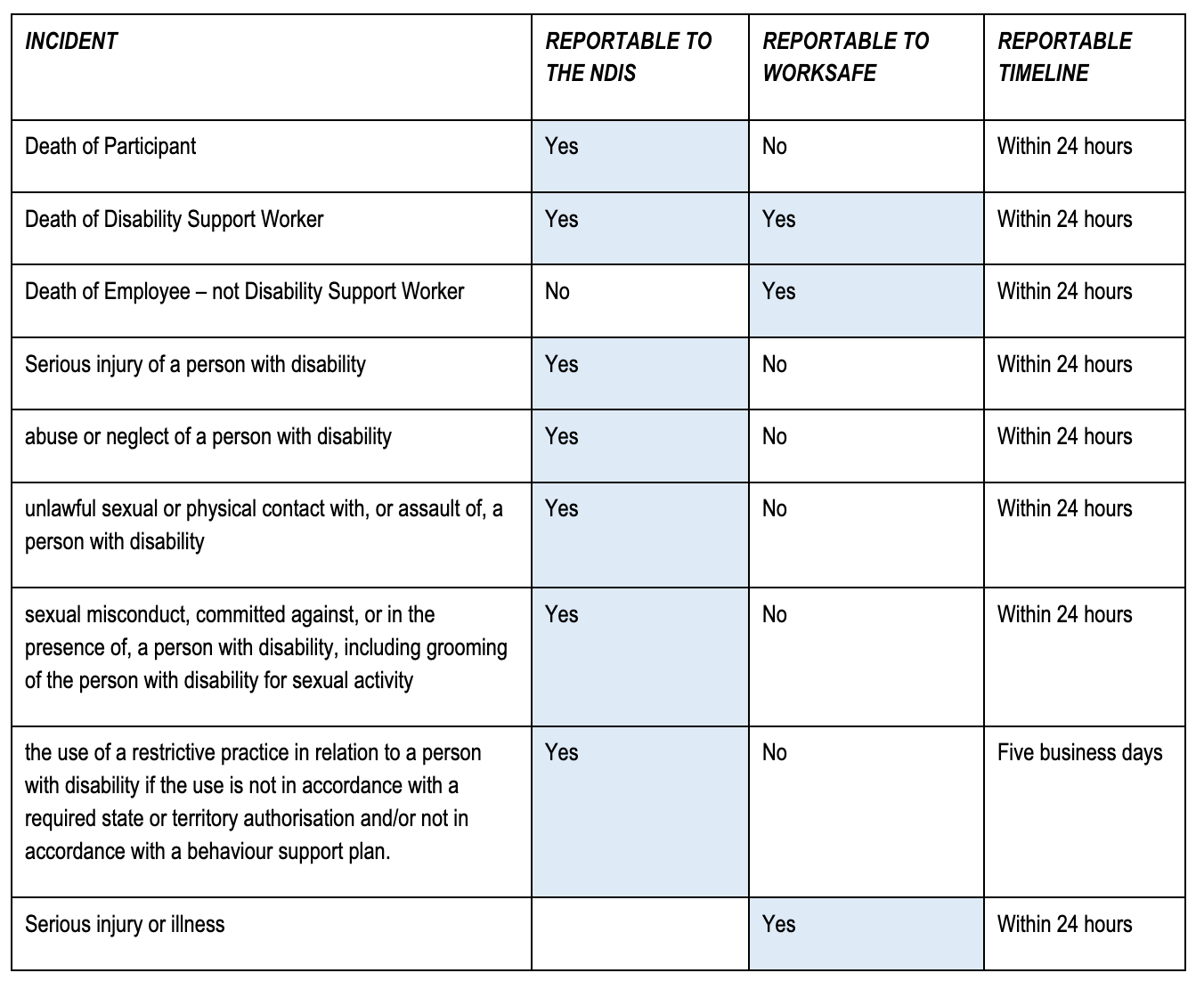
For an incident to be reportable, a certain act or event needs to have happened (or be alleged to have happened) in connection with the provision of supports or services. This includes:
- the death of a person with disability
- serious injury of a person with disability
- abuse or neglect of a person with disability
- unlawful sexual or physical contact with, or assault of, a person with disability
- sexual misconduct, committed against, or in the presence of, a person with disability, including grooming of the person with disability for sexual activity
- use of a restrictive practice in relation to a person with disability where the use is not in accordance with an authorisation (however described) of a state or territory in relation to the person, or if it is used according to that authorisation but not in accordance with a behaviour support plan for the person with disability
If there is no authorisation process (however described) of a state or territory in relation to the use of the restrictive practice, its use is not a reportable incident if the use is in accordance with a behaviour support plan.
When the Commission receives a reportable incident report, we can take a range of actions. This might include requiring you to undertake specified remedial steps, carry out an internal investigation about the incident, or engage an independent expert to investigate and report on the incident. If a reportable incident raises a serious compliance issue, we have powers to take regulatory action. We can conduct our own investigation and take appropriate enforcement or compliance action such as issuing an infringement notice, a compliance notice or asking a court to impose a civil penalty for a breach of the NDIS Act.
We take a responsive and proportionate approach to regulation, providing guidance to build the capacity of NDIS providers to prevent and respond to incidents where possible. We will work with NDIS providers to help them comply with the quality and safeguards requirements, including through education and training about their obligations.
When notifying us of a reportable incident, you must follow the set processes and provide the required information as set out on the ‘My Reportable Incidents’ page on the NDIS Commission Portal.
WHAT IS A REPORTABLE INCIDENT – ‘SAFE WORK AUSTRALIA’
Under work health and safety legislation, certain 'notifiable incidents' must be immediately reported to SafeWork NSW. These incidents may relate to an employee, contractor or member of the public.
A notifiable incident is:
- the death of a person
- a serious injury or illness
- a dangerous incident.
You must notify SafeWork NSW immediately you become aware of the notifiable incident.
In addition to providing first aid where required, you must also:
- secure the site and take care not to disturb anything until an inspector attends to carry out an investigation
- record the incident in the register of injuries
- records must be kept for 5 years from the date of notification
- notify your insurer within 48 hours.
Ensure that procedures have been put in place, so work health and safety incidents are promptly reported to the people responsible for notifying SafeWork NSW.
Significant penalties apply if you fail to report a notifiable incident.
Health Staff Global Pty Ltd. Management must notify the regulator immediately after becoming aware of a ‘notifiable incident’.
The notice must be given by the fastest possible means—which could be by telephone or in writing, for example by email or online:
SafeWork NSW – 13 10 50 or go to audit www.safework.nsw.gov.au
Regulators have adopted a common-sense approach to assessing whether an incident has been notified immediately. This means incidents must be notified as soon as the particular circumstances permit.
In general a PCBU ‘becomes aware’ of a notifiable incident once any of their supervisors or managers becomes aware of the incident. For example when a worker suffers a serious injury and reports it to their immediate supervisor, it is at this point that the PCBU is considered to be aware of the incident.
It is therefore essential to develop internal communication systems to ensure health or safety incidents are promptly brought to the relevant persons’ attention.
5 REPORTING TIMELINE

6 PROCEDURES
See Appendix A – Incident Flowcharts
7 RESPONSIBILITIES
Managers and Supervisors must:
- Implement and review this policy;
- Inform all workers of this policy;
Workers must:
- Comply with the rules of this policy
MANUAL HANDLING POLICY
POL010
1 Introduction
Health Staff Global Pty Ltd is committed to preventing any injury or ill health due to manual handling in the workplace and has developed the following policy to create healthy and safe workplace(s) for all workers, subcontractors and visitors. This policy outlines the rules and responsibilities for hazardous manual tasks.
A hazardous manual task, as defined in the WHS Regulations, means a task that requires a person to exert force to lift, lower, push, pull, carry or otherwise move, hold or restrain any person, animal or thing involving one or more of the following:
- repetitive or sustained force;
- high or sudden force;
- repetitive movement;
- sustained or awkward posture; and/or
- exposure to vibration.
These factors (known as characteristics of a hazardous manual task) directly stress the body and can lead to injury.
2 SCOPE
This policy applies across the organisation of Health Staffing Australia and all workplaces under our control.
3 RULES
- Assess the hazards of all manual handling task using the Manual Handling Hazard Checklist and take action to eliminate or control the risks;
- Where hazards cannot be eliminated always use lifting devices / aids to minimise the risk or ask for assistance from other workers;
- Workers are to notify the manager/ supervisor if they believe a task to be hazardous or beyond their capabilities;
- Follow suggested procedures for eliminating or controlling the risks set out in the Manual Handling Safe Work Method Statement (SWMS); and
Workers whose behaviour has placed the safety of themselves or other at risk will be subject to disciplinary procedures.
4 RESPONSIBILITIES
Managers and Supervisors must:
- Implement and review this policy;
- Consult with workers about this policy;
- Assess the hazards and risks of manual handling identified in the Manual Handling Hazard Checklist and take into account the experience, skills and physical abilities of the workers performing the tasks;
- Assess the ergonomic design of work areas that may pose hazards to workers and eliminate or control the risks;
- Provide appropriate lifting devices/aids to control the risks from manual handling task;
- Provide information, training and supervision for workers to allow them to adhere to the rules and have the knowledge and resources to follow the procedures and understand their roles and responsibilities; and
- Record all injuries arising from manual handling.
Workers’ Must:
- take reasonable care of the health and safety of themselves and others in the workplace;
- co-operate with officer or supervisor in complying with this policy;
- comply with all lawful instructions, information and training provided in relation to health and safety by manager or supervisor;
- comply with risk control measures as instructed and trained;
- notify manager or supervisor about any matter known to them that affects or might affect the ability to comply with this policy; and
- Comply with the rules of this policy.
OVERTIME POLICY: THE EARNINGS THRESHOLD
POL011 Overtime Policy
Overtime policy: the earnings threshold
1.1 Introduction
Overtime and the payment for it is another hugely contentious issue. Usually, the confusion and argument hinges around the employer’s complete misunderstanding of the Ministerial Determination on the earnings threshold.
1.2 The overtime threshold
This Ministerial Determination is commonly referred to by thousands of employers as “the overtime threshold.” It is referred to as “the threshold over which I can force him to work overtime without pay.”
Sometimes also referred to as “the threshold over which he cannot refuse to work overtime without pay.”
Many, many thousands of employers are under this false notion. A Ministerial Determination lays down the "earnings threshold", and certain sections of the BCEA do not apply to employees earning above this threshold amount.
The determination reads as follows:
Government Notice: DEPARTMENT OF LABOUR
BASIC CONDITIONS OF EMPLOYMENT ACT, 1997 DETERMINATION: EARNINGS THRESHOLD
Mildred Oliphant, Minister of Labour, in terms of Section 6(3) of the Basic Conditions of Employment Act, No. 75 of 1997, (the Act), determine that all employees earning in excess of R205 433 per annum be excluded from sections 9, 10, 11, 12, 14, 15, 16, 17(2), 18(3) of the Act with effect from 1 July 2014. For the purposes of this notice: Earnings" means the regular annual remuneration before deductions, i.e., income tax, pension, medical and similar payments but excluding similar payments (contributions) made by the employer in respect of the employee: Provided that subsistence and transport allowance received or achievement awards, intermittent payments for occasional overtime shall not be regarded as remuneration for the purpose of this notice.
We do not know the reason this determination was made - there does not seem to be any purpose behind it, unless it was thought that employees who earn what is perceived as a lot of money, should not enjoy the same privileges as employees who do not earn a lot of money.
Because employees earning more than the threshold amount above are excluded from these sections, the employer has interpreted this to mean that the employee can be forced to work any number of normal working hours that the employer requires, and that he can be forced to work any amount of overtime, including Sundays and public holidays, without any remuneration or compensation whatsoever. In other words, they interpret these exclusions to mean that, “in terms of the law”. The employee is not entitled to any payment for overtime worked.
That is certainly not the case.
The act also states in certain chapters that those chapters, including section 9 and 10, do not apply to senior managerial employees.
1.3 Senior managerial employees
In terms of the act, a senior managerial employee means an employee who has the authority to hire, discipline and dismiss employees, and to represent the employer internally and externally. You must carefully note the word “and “. This implies that all the conditions mentioned in the preceding paragraph must be present for that person to be classed as a "senior managerial employee" for the purposes of the Act
If for example, the employee has the authority to hire and discipline employees, but he does not have the authority to dismiss employees, then he is not a senior Managerial employee for the act, even if he holds the job title of "Operations Manager" or "Purchasing Manager."
Regarding persons earning above the threshold amount, the exclusion from the sections mentioned merely means that the employee does not have a legal entitlement - he does not have the law to back him up - regarding his normal working hours and overtime hours.
However, in terms of section 48 of the act, forced labor is prohibited, and section 48 does apply to all employees including those earning above the threshold and to the so-called "senior managerial employee."
Therefore, the meaning of the exclusion is purely and simply that the employee earning above the threshold cannot demand to be paid for overtime worked or for excessive hours worked, because he has no legal entitlement to demand such payment.
But the employer cannot force him to work overtime because the employee cannot demand compensation for it – section 48 of the act protects the employee against forced labor.
The situation therefore is that employees earning above the threshold must negotiate their normal working hours and overtime hours with the employer, and they must negotiate the rate of pay or compensation for overtime hours worked.
The employee still has the right to refuse to work more than normal time and refuse to work overtime if the employer is not prepared to compensate.
Thus, the position is as follows:
Every employee - irrespective of earnings - is entitled to be paid a fair reward for his labors - including overtime worked, and including public holidays and Sundays worked. No employee - irrespective of earnings, can be forced to work if he does not agree to work it.
Eventually, you are going to have a need for your staff to work overtime.
You must firstly understand the Basic Conditions of Employment Act in this respect, which limits overtime to a maximum of 10 hours per week.
It also stipulates that overtime must be paid for, or, by agreement with the employee, time off can be given instead of payment. The payment rate is 1,5 times the normal wage rate, or it is double the normal wage rate for public holidays and Sundays.
If you are covered by a bargaining council, then you must refer to the Council for overtime conditions.
Overtime can only be done by agreement - therefore it is necessary that the arrangements for the overtime to be worked must be made well beforehand.
The most common method is to draw up a list, which states in the heading the date and from what time the overtime is to be worked, and states what time the overtime shift will end.
Underneath that is a declaration “I understand that by putting my signature next to my name, I agreed that I will work the overtime required as mentioned above.”
Underneath that is a list of employees' names - those required to work overtime - and a place for each employee's signature. By signing next to his name, the employee agrees to work the overtime
If the employee fails to arrive for the agreed overtime, disciplinary action can be taken for gross insubordination - this will attract, at the very least, a final written warning.
1.4 The overtime policy
Stipulate in the employment contract those conditions under which certain overtime may be compulsory.
For example, overtime and may be compulsory for all staff at stock take, or it may be compulsory for maintenance staff during the shutdown, or at other times of the year when planned maintenance work is carried out, and so on.
Apart from that, your policy will stipulate that from time to time it is necessary for staff to work overtime, in order to catch up on work that has become behind for whatever reason, urgent work, work which cannot be delayed or left until the next day, and circumstances like that.
The policy will state that employees would be required to agree in writing to work the overtime as and when it is required, and that should the employee agreed to work the overtime but then fail to work as per the agreement, disciplinary action will be taken, which will lead to a minimum sanction of a final written warning, or possibly dismissal.
MOBILE PHONE POLICY
POL012
- INTRODUCTION
Health Staff Global Pty Ltd has developed this policy to outline the safe and responsible use of Mobile Phones provided by the company for workers. There is no scientific data yet to prove there are any long-term effects to mobile phone usage, although the distraction of using a mobile phone while needing to concentrate on driving a vehicle or operating other machinery is a real risk to the safety of the operator and others nearby. This policy outlines the rules, responsibilities and procedures for the company’s mobile phones and usage.
2. SCOPE
This policy applies across the organisation of Health Staff Global Pty Ltd and all workplaces under our control.
3. RULES
- Limit the number and duration of calls where practical;
- Always use a hands-free set when using your mobile phone especially when driving, although it is recommended to avoid using the mobile phone while driving as it can be a distraction;
- Turn off the mobile phone at service stations;
- Notify the manager/supervisor if the mobile phone has been damaged, lost or stolen. Maintain the batteries in accordance with the manufacturer’s recommendations;
- All mobile phones, data, information, and numbers issued to workers and collected during work activities remain the property of the company and must be returned if employment ceases; and
- Workers whose behaviour has placed their safety or others at risk will be subject to disciplinary procedures.
4. RESPONSIBILITIES
Managers and Supervisors must:
- Implement and review this policy;
- Inform all workers of this policy;
- Make sure that all workers understand the organisation’s mobile phone policy and their roles and responsibilities;
- Issue all mobile phones and record in the Tools and Equipment Register - Worker;
- Provide hands free sets with the mobile phone particularly if driving is part of the workers work; and
- Monitor mobile phone usage;
Workers must:
- Comply with the rules of this policy;
- Use and care for the phones in their possession in a responsible manner;
- Use the mobile phone for work purposes only; and
- Always have the phone accessible during work hours.
FIRST AID POLICY
POL013
- INTRODUCTION
Health Staff Global Pty Ltd has developed this policy to provide a safe and healthy workplace for all workers, subcontractors, and visitors. This policy outlines the rules, responsibilities, and procedures for First Aid. Health Staff Australia is committed to providing prompt and effective first aid treatment to all people in the workplace to minimise the severity of an injury or illness.
2. SCOPE
This policy applies across the organisation of Health Staff Global Pty Ltd and all workplaces under our control.
3. RULES
- All workers are to know the location of the first aid kit and who and how to contact the first aid officer; and
- Report all injuries so they can be treated and recorded in the Incident and Injury Register.
4. RESPONSIBILITIES
Managers and Supervisors must:
- Appoint a First Aid officer(s) with a current First Aid certificate for the workplace and each worksite;
- Clearly identify First Aid roles and responsibilities;
- Have an effective, prompt and coordinated approach to the provisions of First Aid to all workers and visitors;
- Provide nationally recognised First Aid training for worker(s) appointed as First Aid officers;
- Arrange refresher courses for First Aid officers before their certificates expire;
- Pay First Aid allowance to workers appointed as First Aid officers;
- Provide First Aid kits appropriate for the number of workers and the workplace, and the treatment of injuries and illnesses identified during the risk management process. First aid kits must be kept in a prominent, clean, and easily accessible location known to all workers and portable first aid kits available to remote workers.
- First aid facilities appropriate for the number of workers and the workplace; and
- Consult with workers about this First Aid Policy so workers can contribute to decisions effecting their health, safety, and welfare.
Workers must:
- Comply with the rules of this policy;
- Respond to any reasonable request to help with first aid; and
- Participate in workplace consultation and/or training regarding first aid.
First Aid Officers must:
- Provide a quick and competent first aid response;
- Recognise their limitations and only administer or carry out duties that have been included in their training;
- Remain with an injured or ill person until no further treatment or assistance is required, or until the person is handed over to ambulance or other medical personnel, unless the officer’s personal safety is at risk;
- Fulfil their responsibilities and maintain their qualifications to continue the appointment as a First Aid officer;
- Provide initial First Aid attention when necessary to any worker and the public whilst on work premises;
- Conduct monthly audits on the contents of all First Aid kits and restock supplies when required including when use by dates have expired;
- Make sure a notice is displayed, on or near any First Aid Kit they are responsible for, detailing their name, telephone number and work location;
- Always Carry their current First Aid certificates on them; and
- Keep a record all injuries and illness in the Incident and Injury Register. The register must be kept at the workplace for seven years.
EQUAL EMPLOYMENT OPPORTUNITY POLICY
POL014
- INTRODUCTION
Health Staff Global Pty Ltd has developed the following policy to create a safe and healthy workplace for all workers, subcontractors, and visitors. This policy outlines the rules, responsibilities and procedures for Equal Employment Opportunity and proposes the organisation and its workers do not discriminate against another person based on their sex, age, race, skills and experience, physical and mental abilities, marital status, political views, or trade union association.
2. SCOPE
This policy applies across the organisation of Health Staff Global Pty Ltd and all workplaces under our control.
3. RULES
- Health Staff Global Pty Ltd will not discriminate against anyone in our recruitment practices or in the delivery of our goods and services. All recruitment selection will be based on the applicants’ qualifications, skills, and experience in relation to the proposed position. Internal promotions will be based on the best person that meets the requirements for the position; and
- No worker or officer is to discriminate, harass or victimise another worker, client or other person while representing this organisation, non-compliance will result in disciplinary action.
4. RESPONSIBILITIES
Officers and Supervisors must:
- Identify all hazards in the workplace and assess each hazard’s potential to harm, considering the age, experience, skill and physical ability of the worker and investigate options for eliminating or controlling the hazards;
- Monitor work conditions and work performance;
- Implement and review this policy;
- Consult with workers about this policy;
- Make sure that all workers understand the organisation’s Equal Employment Opportunity Policy and their roles and responsibilities;
- Make sure all workers are professionally trained in workplace hazards and safe work practices with consideration to their age, experience, and skill and in accordance with their roles and responsibilities;
- Provide information to all young workers about the potential hazards encountered at work to make sure they can undertake their work safely;
- Make sure that all young workers are aware of their duties and rights when they encounter workplace hazards;
- Provide careful supervision until a young worker is competent to carry out the tasks required;
- Adjust accommodate specific needs of pregnant women to ensure their health, safety, and welfare in the workplace;
- Implement corrective or disciplinary procedures;
- Provide safety training and information to workers where language and/or literacy may be an issue, in a format that is appropriate for their needs;
- Keep confidential records of any unfair work practices against any worker; and
- Provide a fair and equal workplace for all workers.
Workers must:
- Comply with the rules of this policy;
- Report to their officer or supervisor any discrimination or unfair treatment in the workplace; and
- Advise their supervisor if they feel unsafe performing any work activity or if they feel they have not been professionally trained.
CORONAVIRUS (COVID-19) POLICY
POL015
- INTRODUCTION
Health Staff Global Pty Ltd is committed to the protection of the health, safety and welfare of workers and others when in the workplace. The organisation commits to implementing practices that minimise the risk of cross contamination.
A novel (new) strain of coronavirus which originated in Hubei Province, China in 2019 can cause a respiratory disease called COVID-19. Health Staff Global Pty Ltd and workers will identify and manage work health and safety risks including the exposure to COVID-19. Health Staff Global Pty Ltd will respond to cases of COVID-19 at work in line with advice provided by Australian Government Department of Health www.health.gov.au.
COVID-19 spreads from person to person in an equivalent way to the flu:
- from close contact with an infected person;
- from touching objects or surfaces contaminated by the sneeze, cough or contact with an infected person and then touching your eyes, nose, or mouth.
COVID-19 can cause symptoms like the flu, including fever, cough, sore throat, tiredness, or shortness of breath. Most people who are infected experience mild to moderate symptoms from which they fully recover. However, some people develop more serious illnesses with pneumonia and other complications. People at increased risk of serious illness include the elderly and those with chronic medical conditions (e.g., diabetes, heart, and lung disease) or a weakened immune system.
It is important to remember that most people who become ill with respiratory symptoms at work are suffering from a cold, the flu or other respiratory illness – not COVID-19.
To achieve a safe working environment, the following hygiene practices will be implemented:
- Social distancing (staying more than 1.5m away from others)
- Effective handwashing;
- Hygienic cleaning techniques;
- Safe handling and disposal of waste.
This policy will be modified and / or updated when and where appropriate based on consultation with workers and advice provided by Australian Government Department of Health www.health.gov.au.
2. SCOPE
This policy applies across all departments of Health Staff Australia and across all workplaces under this organizations control, including subcontractors and visitors to the workplace.
3. RESPONSIBILITIES
Health Staff Global Pty Ltd will:
- Inform and encourage all workers to download and use the official Government “Coronavirus Australia” app to stay informed;
- Make sure social distancing measures are carried out and enforced;
- Provide hand washing facilities and make sure these are kept clean, properly stocked and in good working order;
- Provide alcohol-based hand sanitizer, antibacterial wipes, tissues, and cleaning supplies;
- Promote good hygiene practices, e.g. display posters on handwashing and respiratory hygiene;
- Keep the workplace clean and hygienic. Regularly cleaning and sanitizing high-touch surfaces such as door handles and workstations to prevent contamination;
- Visit the Smartraveller website before arranging business travel to destinations with cases of Covid-19. Workers who become sick while travelling or after returning from affected areas should seek immediate medical advice and notify their employer;
- Encourage workers who are sick with respiratory illness to stay home until they are recovered;
- If someone becomes ill with respiratory symptoms at work, arrange for the person to be sent home and advise them to seek medical advice. If required, call an ambulance;
- If a worker is confirmed to have COVID-19, contact the Australian Government Department of Health www.health.gov.au for advice. Inform co-workers about exposure to COVID-19 but maintain confidentiality. Advise workers to seek immediate medical advice if they develop symptoms or are concerned about their health.
Workers, Subcontractors and Suppliers must:
- Download and use the official Government “Coronavirus Australia” app to stay informed;
- Practice good hygiene to protect their own health and the health and safety of other persons in the workplace;
- Maintain social distancing when at work and travelling to and from work;
- Wash your hands frequently with soap and water or use an alcohol-based hand sanitiser;
- Cover your nose and mouth with a tissue or flexed elbow when coughing or sneezing, dispose of tissues immediately after use and wash your hands or apply hand sanitiser;
- Avoid contact with anyone who has cold or flu-like symptoms;
- Stay home if you are unwell;
- Wear appropriate personal protective equipment and clothing;
- Cooperate with Persons Conducting Business or Undertaking (PCBU) in their efforts to comply with workplace hygiene and social distancing requirements.
Failure to comply or observe with a direction regarding Work Health and Safety may be considered a breach of the terms of employment or contract and sufficient grounds for termination of employment or the contract.
4. SELF-ISOLATION
Workers and others cannot go to work and must self-isolate for 14 days if they have:
- recently travelled to an overseas destination;
- been in close contact with a confirmed case of COVID-19.
Workers who need to self-isolate should notify their employer and stay away from work. If they develop symptoms including a fever and cough they should seek medical advice.
Workers who think they may have been in close contact with a confirmed case of coronavirus, should also isolate at home, monitor their health, and seek medical advice if key symptoms develop. Workers should advise their employer if they develop symptoms during the self-isolation period, particularly if they have recently been in the workplace.
Health Staff Global Pty Ltd will make appropriate arrangements so that workers who need to self-isolate stay away from work. Where possible, the worker may be provided with flexible work arrangements such as working from home.
5. HAND WASHING AND CLEANING SURFACES
Hand washing is the most effective way of maintaining good hygiene practices and preventing cross-contamination. Wash hands with soap (from a dispenser or pump pack) and water:
- Before and after handling food;
- Before eating, drinking, or smoking;
- Before and after any contact with clients e.g., invasive, or non-invasive procedures;
- After handling any soiled clothing or linen;
- After using bathroom or toilet;
- After blowing nose or coughing into tissue or other material;
- When entering a new work environment.
Use the following method when washing hands:
- Remove all wrist and hand jewelry and watches;
- Wet hands;
- Use soap and spread over hands;
- Rub hands vigorously as they wash for 20 seconds, cleaning palms, backs of hands, in between fingers and under fingernails;
- Rinse hands thoroughly;
- Pat dry hands with paper towel and turn the tap off with the paper towel;
- Dispose of hand towel in bin.
Cleaning and Sanitising Surfaces
During all hours of operation, visually, and physically inspect all surfaces of equipment, workstations, and any other high touch surfaces to ensure they are clean. Wash, rinse, and sanitise surfaces regularly.
Make sure workers wear gloves and use alcohol-based hand sanitiser before and after wearing gloves to minimise the risk of infection.
If cleaning rooms or areas of the workplace where a person with a confirmed case of coronavirus, or a person in isolation has frequented, workers should wear a surgical mask as an added precaution. If a confirmed case of coronavirus or a person in isolation is in a room that cleaning staff need to enter, they may ask them to put on a surgical mask if they have one available.
5. PERSONAL PROTECTIVE EQUIPMENT (PPE)
PPE should be worn by:
- People with suspected or confirmed COVID-19 as advised by their doctor or Department of Health.
- People who have been in close contact with suspected or confirmed cases of COVID-19 (e.g., healthcare workers).
PPE guidance for specific industries is available at www.health.gov.au.
Surgical masks can help prevent the spread of disease from infected people to others but are not currently recommended for healthy members of the public to prevent COVID-19.
DRUG AND ALCOHOL POLICY
POL016
- INTRODUCTION
The abuse of alcohol and other drugs can damage physical and mental health and impair judgement and behaviour of those affected that may cause them to injure themselves or others. This places workmates in the uncomfortable position of feeling obliged to cover for poor work performance or dob in a mate for their own good. Health Staff Australia has developed the following policy to create a healthy and safe workplace for all workers, subcontractors and visitors. This policy outlines the rules, responsibilities and procedures for drug and alcohol use.
2. SCOPE
This policy applies across the organisation of Health Staff Global Pty Ltd and all workplaces under our control.
3. RULES
- All workers must have a Blood Alcohol Reading of 0.00ml/l. When a company event is to take place onsite an approval must be given from management.
- Workers must not consume or be under the influence of alcohol or other drugs while at work or during their work for Health Staff Global Pty Ltd or they will be subject to disciplinary action that may result in termination of employment;
- Not drive a vehicle on work-related business or to and from work if his/her blood alcohol concentration (BAC) level is above 0.00ml/l or if under the influence of any drugs which may impair their ability to drive;
- Workers who require prescription or over the counter medication for a particular condition or illness, must notify management of the medication they are taking and any side effects that may occur. The worker will perform suitable duties while taking the medication. Should the medication be required for long term or permanent use and affects the worker doing their core responsibilities, consultation with their doctor may be required;
- No worker is to commence work, or return to work while affected by alcohol or other drugs;
- Workers who are aware that their co-workers or a subcontractor are affected by alcohol or drugs and believe that person’s ability to work safely may be impaired, have a responsibility to report it to their supervisor/health and safety representative (HSR) so action may be taken immediately; and
- Workers that are aware that a visitor to the workplace is affected by alcohol or drugs and believe the visitor could affect the health and safety of any person, have a responsibility to report it to their supervisor/health and safety representative (HSR) immediately. If the supervisor believes the visitor’s behaviour is unacceptable, immediate action is to be taken including removal of the visitor from the workplace.
4. RESPONSIBILITIES
Managers and Supervisors must:
- Monitor work conditions and work performance;
- Approach people in the workplace who may be affected by alcohol or other drugs;
- Approach a worker who may have ongoing alcohol or drug-related problems that are affecting their work;
- Encourage and refer workers to support and counselling as appropriate;
- Implement corrective or disciplinary procedures;
- Keep confidential records of alcohol or drug-related incidents or events;
- Implement responsible service of alcohol measures at approved work functions;
- Implement and review this policy;
- Make sure that all workers understand the organisation’s Drug and Alcohol Policy and their roles and responsibilities;
- Provide information to all workers about the potential health and safety impacts of alcohol and drugs at work;
- Provide appropriate training to workers according to their roles and responsibilities; and
- Consult with workers about this Drug and Alcohol Policy so employees can contribute to decisions effecting their health, safety and welfare.
Workers must:
- Comply with the rules of this policy;
- Participate in consultation, company initiatives and any training in relation to alcohol and drug use; and
- Discuss the matter with their supervisor or other designated person and seek appropriate support if they are experiencing alcohol or drug related problems.
SHIFT WORK POLICY
POL017
Health Staff Global Pty Ltd has developed the following policy to create a safe and healthy workplace for workers, and others. Shiftwork can lead to stress or excessive fatigue due to the disturbances in the body’s natural rhythms and may influence safe work practises. This policy outlines the rules, responsibilities, and procedures for Shiftwork.
- SCOPE
This policy applies across the organisation of Health Staff Australia and across all workplaces under this organisations control.
2. RULES
- Report incidents/ accidents, near misses and other hazards; and
- Notify the officer/supervisor if fatigue may affect work safety.
3. RESPONSIBILITIES
Managers and Supervisors must:
- Implement and review this policy;
- Monitor work conditions and work performance;
- Approve all rostered shifts;
- Approve all on call shifts;
- Approach a worker if their fatigue may affect work safety;
- Keep confidential records of injuries and ‘near misses’;
- Provide information to and train all workers about the potential health and safety impacts of fatigue at work; and
- Meet with workers to consult them on all issues of Work Health and Safety (WHS) in particular hazard identification and hazard control, safe work procedures and training.
Workers must:
- Comply with the rules of this policy;
- Participate in any training relating to this policy;
- Utilise breaks provided within and between shifts to rest and recuperate;
- Recognise signs of sleep deprivation and/or fatigue and the impact on themselves and others and report to their manager or supervisor the circumstances in which fatigue and lack of sleep are impacting on individual well-being and workplace safety; and
- Report incidents/ accidents, near misses and other hazards to relevant manager.
STRESS AND FATIGUE POLICY
POL018
- INTRODUCTION
Stress and fatigue can reduce reaction times and thereby compromise the ability of a person to work safely. Health Staff Global Pty Ltd has developed this policy to provide a healthy and safe workplace for workers and others. This policy outlines the rules, responsibilities and procedures for Stress and Fatigue.
2. SCOPE
This policy applies across the organisation of Health Staff Global Pty Ltd and all workplaces under our control.
3. RULES
- Workers must notify their manager/supervisor if they feel excessively fatigued and their ability to work safely may be effect;
- Workers are encouraged to talk to their managers/supervisors if they feel their ability to work safely is impaired by stress due to work or personal matters.
4. RESPONSIBILITIES
Managers and Supervisors must:
- Implement and review this policy;
- Consult with workers about the effects of stress and fatigue in the workplace and this policy;
- Provide resources, information, training and supervision for all workers to allow them to adhere to the rules and have the knowledge and resources to follow the procedures and understand their roles and responsibilities;
- Assess the nature and scale of workplace risks to health and make sure there are adequate control measures in place;
- Deal with conflict in the workplace;
- Monitor and review stress and fatigue in the workplace;
- Adjust and monitor exposure to hazards during extended working hours;
- Provide training on fatigue and stress management; and
- Modify work methods as needed to reduce stress-causing hazards.
Workers must:
- Comply with the rules of this policy; and
- Report all accidents and near misses.
TRAINING AND COMPETENCY POLICY
POL019
- INTRODUCTION
Health Staff Global Pty Ltd has developed this policy to provide a healthy and safe workplace for all workers, subcontractors, and visitors. Health Staff Global Pty Ltd is committed to providing the necessary information, training, and supervision to make sure our workers are competent in the tasks they perform and do not pose a risk to their own and others health and safety. This policy outlines the rules, responsibilities and procedures for training and competency.
2. SCOPE
This policy applies across the organisation of Health Staff Global Pty Ltd and all workplaces under our control.
3. RULES
- All workers, subcontractors and visitors must be inducted to the workplace;
- All workers must receive training or demonstrate competency, qualifications, or licences prior to commencing work;
- Proof of current qualifications through demonstration, certificates and licenses must be provided to the manager/supervisor prior to commencing work; and
- Make sure visitors are provided with suitable supervision in the workplace.
4. RESPONSIBILITIES
Managers and Supervisors must:
- Implement and review this policy;
- Consult with workers about this policy;
- Make sure that all workers understand the organisation’s Training and Competency Policy and their roles and responsibilities;
- Identify if workers are qualified or certified to undertake tasks;
- Provide appropriate training, instruction and supervision for workers who lack experience or competency;
- Monitor the general conduct of work for compliance with Work Health and Safety (WHS) regulations, procedures, and safe work practices;
- Record workers skills and competency; and
- Keep a register of training attended by workers.
Workers must:
- Comply with the rules of this policy;
- Demonstrate they have the appropriate skills and experience to perform work activities safely or participate in training; and
- Current licenses and certificates must always be available.
VEHICLE AND EQUIPMENT USAGE POLICY
POL020
- INTRODUCTION
Health Staff Global Pty Ltd has developed this policy to provide a healthy and safe workplace for all workers, subcontractors, and visitors. This policy outlines the rules, responsibilities and procedures for Vehicles and equipment.
2. SCOPE
This policy applies across the organisation of Health Staff Global Pty Ltd and all workplaces under our control.
3. RULES
Only staff members holding a valid current driver licence (of the appropriate class) acceptable in Australia, and which has been provided in copy for records to the company may drive a company vehicle.
Authority to drive lapses if:
- a person no longer holds an acceptable current driver licence of the appropriate class and/or
- driver has not supplied a copy of relevant license to head office.
- the Director revokes an authority to drive for a reason relating to unsatisfactory driving or non-observance of company procedures or otherwise
- the relevant person ceases to be a staff member.
Other persons who may be required to drive a vehicle require the prior approval of the Director. Vehicles are not to be used for private use unless authorised by the managing director
Drivers are required to take regular breaks. It is suggested that drivers rest every two hours for 15 minutes and should not drive for more than 10 hours in a 24-hour period.
Drivers on a probationary “P” license must display “P” plates, when driving Vehicles.” P” platers are not able to drive vehicles provided through rental hire agreements. Drivers on learner’s permits are not allowed to drive company Vehicles.
All drivers must ensure due care is taken and comply with relevant legislation and road rules.
All vehicles and equipment used in the workplace must have a current service / maintenance record.
All workers must be trained, certified or licensed and competent to operate specific vehicles and equipment;
Make sure workers and others are aware of the hazards and risks associated with the vehicles and equipment in the workplace;
If vehicles and equipment or the environment becomes unsafe, cease operation until risks have been eliminated or controlled; and
In the event of an accident that may have caused injury to a person or damage to vehicle or property, Supervisor or manager must be contacted as soon as reasonably practicable, and all information pertaining to the accident recorded and reported within 48 hours of the occurrence.
4. RESPONSIBILITIES
Managers and Supervisors must:
- Implement and review this policy.
- Consult with workers regarding this policy.
- Provide resources, information, training, and supervision for workers to allow them to adhere to the rules and have the knowledge and resources to follow the rules, procedures and understand their roles and responsibilities.
- Maintain vehicles and equipment to comply with Australian Standards and / or manufacturer’s recommendations
- Make sure all vehicles are in good working order.
- Carry out appropriate checks and inspections to the vehicle and equipment as per manufacturer’s instructions;
Record all incidents and near misses.
Workers must:
- Comply with the rules of this policy.
- Participate in consultation and training regarding using company vehicles.
- No worker is to interfere or alter any vehicle or equipment.
- Carry out regular inspection and maintenance of vehicles and equipment before and during use;
- Have relevant certificates or licenses to operate any vehicle or equipment.
- Report any fault to their manager/supervisor; and
- Report all hazards, incidents and near misses to their manager/supervisor.
WORKPLACE CONSULTATION POLICY
POL021
- INTRODUCTION
Health Staff Global Pty Ltd has developed the following policy to create a safe and healthy workplace for workers, and others. This policy outlines the rules, responsibilities, and procedures for Workplace Consultation. Through consultation workers can contribute to health and safety issues that may affect them and their welfare. This consultation process allows us to become more aware of hazards and Work Health and Safety (WHS) issues experienced by workers and involve them in addressing potential problems before they escalate and affect our business.
2. SCOPE
This policy applies across the organisation of Health Staff Global Pty Ltd and all workplaces under our control.
3. RULES
- Consultation is required when;
- identifying hazards and assessing risks arising from WHS matters arising from the work be carried out;
- making decisions about ways to eliminate and minimise those risks;
- making decisions about the adequacy of facilities for the welfare of workers;
- carrying out any other activity prescribed by the Regulations.
- proposing changes that may affect the health and safety of workers; and
- making decisions about procedures for:
- consultation
- resolving WHS issues
- monitoring health of workers
- monitoring conditions at the workplace under
- the management of the PCBU
- providing information or training for workers
- Participate in workplace consultation and training; and
- Attend WHS meetings when and if required to consult on health and safety issues.
4. RESPONSIBILITIES
Managers and Supervisors must:
- Consult with workers to decide on workplace consultation arrangements and record the agreed outcomes and make sure all workgroups are represented and informed;
- Consult with workers who carry out work for the business or undertaking who are, or likely to be, directly affected by a WHS matter.
- Provide resources, information, and training for workers to allow them to understand work health and safety issues so they have the knowledge to make informed decisions. Hazard identification, hazard control and safe work procedures;
- Hold meetings to consult with workers, or committee members to enable them to contribute to the decisions that may affect their health, safety and welfare;
- Provide sufficient time to discuss and resolve WHS issues;
- Address safety issues promptly; and
- Document meetings and safety decisions.
Workers must:
- Comply with the rules of this policy;
- Report all incidents, accidents, near misses and hazards to the Managers/supervisor;
- Participate in any consultation and training relating to this policy; and
- Raise any health and safety concerns for discussion at the meetings or with their manager.
SMOKE–FREE WORKPLACE POLICY
POL022
- INTRODUCTION
Health Staff Global Pty Ltd has developed this policy to provide a healthy and safe smoke-free workplace for all workers and others. There are many studies to indicate the harmful effects of smoking and passive smoking. This policy outlines the rules, responsibilities and procedures for a smoke-free workplace.
2. SCOPE
This policy applies across the organisation of Health Staff Global Pty Ltd and all workplaces under our control.
3. RULES
- No smoking is allowed in any indoor or enclosed areas including the toilets, corridors and company vehicles;
- No smoking within 10 meters of non-smokers, buildings, exits or air intake systems;
- Smoke breaks are to be taken in worker’s official meal breaks only;
- Smoking is only allowed in the designated smoking areas when provided;
- Notify the manager/supervisor of any breaches to the Smoke-free Workplace Policy; and
- Smokers must not smoke near materials or substances that are flammable, hazardous or dangerous.
4. RESPONSIBILITIES
Managers and Supervisors must:
- Implement and review this policy;
- Consult with workers about this Smoke-free Workplace Policy so workers can contribute to decisions affecting their health, safety and welfare;
- Make sure all workers understand the organisation’s smoke-free workplace policy and their roles and responsibilities;
- Provide information to all workers about the potential health and safety impacts smoking has at work;
- Provide access to professional counselling and support services when appropriate;
- Make sure practical measures are undertaken to protect workers in relation to their health, safety and welfare;
- Erect signs using standard symbols clearly indicating to workers and the public that the indoor areas are no-smoking; and
- Inform workers that not complying with the Smoke-free Workplace Policy can mean they are personally liable for a fine under the Work Health and Safety (WHS) Act.
Workers must:
- Comply with the rules of this policy;
- Participate in any consultation and training relating to this policy; and
- Report any worker who is in breach of the policy to the manager/supervisor.
PURCHASING POLICY
POL023
- INTRODUCTION
Health Staff Global Pty Ltd has developed the following policy to create a safe and healthy workplace for workers and others. This policy outlines the rules, responsibilities and procedures for purchasing plant, machinery, tools, furniture, chemicals, supplies and materials in our endeavour to eliminate or minimise the risks to workers.
2. SCOPE
This policy applies across the organisation of Health Staff Global Pty Ltd and all workplaces under our control.
3. RULES
- Undertake training for the use, storage and transportation of the equipment or substance purchased; and
- Use the Purchasing Procedures and Checklist and/or Purchasing Register when purchasing plant, machinery, tools, furniture, chemicals, supplies and materials; and
- Eliminate or mitigate risks associated with purchasing or supplying goods and services by conducting risk assessments prior to purchase.
4. RESPONSIBILITIES
Manager and Supervisors must:
- Consult with workers regarding proposed purchases of new equipment, substances and materials;
- Obtain the risk control strategies for the safe use, transport or storage of any new equipment or substance from the manufacturer, supplier or Australian Standards prior to purchasing;
- Train workers in the safety aspects of the purchased equipment or substance;
- Review Safe Work Method Statement (SWMS) in relation to the newly purchased equipment or substance; and
- Purchase and issue the appropriate PPE for use with the newly purchased equipment or substance.
Workers must:
- Comply with the rules of this policy; and
- Participate in any consultation and training relating to this policy.
SUBCONTRACTOR MANAGEMENT POLICY
POL024
- INTRODUCTION
Health Staff Global Pty Ltd has developed this policy to provide a healthy and safe workplace for workers and others. It is important the subcontractors and their workers work practices of do not pose a risk to health, safety and the environment, and our workplace and workforce does not pose a risk to the subcontractor or their workers. This policy outlines the rules, responsibilities and procedures for subcontractor management.
2. SCOPE
This policy applies across the organisation of Health Staff Global Pty Ltd and all workplaces under our control.
3. RULES
All subcontractors engaged by Health Staff Global Pty Ltd are to adhere to the following requirements:
- Complete the Subcontractor Safety Checklist and provide any supporting documents required;
- Provide a Risk Assessment for the site and Safe Work Method Statements (SWMS) for the tasks for which they are contracted;
- Make sure their or their workers actions do not endanger the health and safety of other workers and visitors in or near the workplace; and
- Report incidents, near misses and hazards to the manager/supervisor;
4. RESPONSIBILITIES
Managers and Supervisors must:
- Implement and review this policy;
- Consult with workers and subcontractors about this policy;
- Make sure subcontractors are provided with the Subcontractor Safety Checklist and it is completed, and any supporting documentation is provided by the subcontractor prior to them commencing work;
- Make sure all subcontractors understand Health Staff Global Pty Ltd policies, safety rules and their roles and responsibilities;
- Make sure any subcontractor is not put at risk by the activities of other workers; and
- Provide a safe and healthy workplace for all subcontractors;
Workers must:
- Work in a manner that does not endanger the health and safety of subcontractors in the workplace.
5. PROCEDURES
Censure or Termination of Contract:
Subcontractors who do not comply with this policy will be subject to the following procedures:
- When a officer/supervisor becomes aware of an alleged breach of Health Staff Global Pty Ltd policies and/or site rules, they will initially speak with the subcontractor as soon as possible after the alleged breach has been reported;
- The subcontractor will have the opportunity within a reasonable time to explain their actions;
- The proceedings will be conducted honestly, fairly and without bias; and
- If the subcontractor does not give reasonable cause for their actions or does not rectify the reason for the grievance/complaint, the Contract will be terminated and the subcontractor removed from the workplace.
OFFICE 365, INTERNET AND EMAIL POLICY
POL025
- INTRODUCTION
Health Staff Global Pty Ltd has developed this policy to outline the responsible use of the Office 365, Internet and Electronic Mail (Email) provided by the company for the use by workers. This policy outlines the rules, responsibilities and procedures for Internet and email use, in particular security, privacy, confidentiality and preventing inappropriate material being downloaded or sent that may offend or insult.
2. SCOPE
This policy applies across the organisation of Health Staff Global Pty Ltd and all workplaces under our control.
3. RULES
- The use of Office 365, Email and the Internet during company time is to conduct company business only. No personal business is to be conducted using the companies email system. All documents created or results of network activity conducted while doing company business and with the company’s resources remain the property of the company;
- The management at Health Staffing Australia reserves the right to monitor, log and/or restrict employee Office 365, email and Internet access without notice;
- Keep email attachments to a minimum of 1 – 5Mb for efficient delivery;
- Workers are prohibited from accessing, displaying, generating or storing any material that is sexually explicit, offensive and discriminatory or contains profanities. Sending emails of a harassing nature or causes offence, embarrassment or humiliation to persons inside or outside of the company is prohibited;
- The use of the internet for any illegal purpose is strictly prohibited;
- Purchasing via email is to be for goods and services required for the company and must have approval from the Managing Director
- Downloading software is prohibited unless approval is given as it may corrupt the system;
- Any worker who is aware of any unauthorised or inappropriate use of email or the Internet must contact the Managing Director; and
- Any worker who does not comply with these rules will be subject to disciplinary action.
4. RESPONSIBILITIES
Managers and Supervisors must:
- Implement and review this policy;
- Inform all workers of this policy;
- Make sure that all workers understand the organisation’s Office 365, Internet and Email Policy and their roles and responsibilities;
- Implement disciplinary procedures when there is abuse of the internet or email; and
- Monitor Internet and email usage.
Workers must:
- Comply with the rules of this policy;
- Participate in consultation and training that relates to this policy; and
- Inform the officer or supervisor if inappropriate emails are received;
PERSONAL PROTECTIVE EQUIPMENT (PPE) POLICY
POL026
- INTRODUCTION
Health Staff Global Pty Ltd has developed this policy to provide a healthy and safe workplace for workers and others. The company will make every effort to eliminate or control risks and only use PPE when there is no other alternative to protect the workers from the hazard. This policy outlines the rules, responsibilities and procedures for PPE use, maintenance and storage.
2. SCOPE
This policy applies across the organisation of Health Staff Global Pty Ltd and all workplaces under our control.
3. RULES
- Make sure the PPE issued is fitted correctly and is appropriate for the tasks performed;
- Wear and use appropriate PPE when required in accordance with manufacturer’s instructions and for its intended purpose;
- Participate in consultation and training regarding the correct fitting, use, maintenance, and storage of PPE;
- Workers must inspect their PPE to make sure it is in good working condition, maintain and store their PPE safely. The PPE remains the property of the company;
- Inform the manager/supervisor if PPE has not been issued or is unsuitable or unwearable; and
- Workers whose behaviour has placed the safety of themselves or other at risk will be subject to disciplinary procedures.
5. RESPONSIBILITIES
Managers and Supervisors must:
- Implement and review this policy;
- Inform all workers of this policy;
- Provide PPE without any cost to the worker;
- Provide resources, information, training, and supervision to allow workers to adhere to the rules and have the knowledge and resources to fit, use, maintain and store their PPE and follow the procedures and understand their roles and responsibilities;
- Consult with workers about the use of PPE;
- Make sure all PPE items purchased are manufactured to the relevant Australian Standards, and used, maintained, and stored in accordance with the manufacturer's recommendations;
- Record all PPE issued to a worker; and
- Replace all PPE due to ‘wear and tear’ by the worker.
Workers must:
- Comply with the rules of this policy; and
- Participate in consultation and training regarding PPE.
CONFLICT RESOLUTION POLICY
POL027
- INTRODUCTION
Health Staff Global Pty Ltd has developed this policy to provide a healthy and safe workplace for workers and others. The company will make every effort to eliminate conflict in the workplace. The intent of this policy is to provide a framework for resolving conflict that affects the function and/or the physical or social environment of Health Staff Global Pty Ltd
2. SCOPE
This policy applies across the organisation of Health Staff Global Pty Ltd and all workplaces under our control.
3. GENERAL PRINCIPALS
It is the intent of this policy to encourage members and employees to resolve conflicts and foster good will through direct dialogue whenever possible, before following formal resolution procedures.
It is also the intent of this policy to keep personal relationships healthy and constructive so that Health Staff Global Pty Ltd can carry out operations.
This policy is intended to work in tandem with existing laws including the Employment Standards Act and the Human Rights Act, and not to supersede those laws or contradict them.
Discipline is intended to conform with the accepted concept of progressive discipline, which is based on increasing warnings and/or penalties for repeat occurrences, rather than being punitive or arbitrary.
Follow disciplinary procedures and counselling as required
4. RESPONSIBILITIES
Managers and Supervisors must:
- Implement and review this policy;
- Inform all workers of this policy;
- Provide support as required under the WHS Act
- Provide resources, information, training, and supervision to allow workers to adhere to the rules and have the knowledge and resources follow the procedures and understand their roles and responsibilities;
- Consult with workers about all matters to reduce conflict;
- Record all conflict issues and; and
- Notify the People and culture department
Workers must:
- Adhere to the WHS Act
- Comply with the rules of this policy; and
- Participate in consultation and training regarding conflict management
5. DEFINITIONS
Manager: The direct manager or Managing director.
Mediation: A process where a neutral third party assists two conflicting people to come to agreement. This could involve the mediator speaking individually to the two people but must include the mediator facilitating a meeting between both conflicting people.
Conflict: A strong disagreement or a dispute between volunteers, between volunteers and employees, between employees, or between board and staff, resulting from differences of opinion, belief or understanding, or differences of personality or behaviour, or violation of policies and procedures or of regulations or laws with which the company is legally obligated to comply, and which negatively affects the functioning of the company or its social environment.
Discipline: Corrective action as prescribed in the Conflicts and Discipline Procedure.
Progressive Discipline: a system of discipline where warnings and/or penalties gradually increase upon repeat occurrences.
Related Policies, Procedures, and Documents
Any policy as it may apply to a specific conflict or disciplinary situation.
Appeals
If a worker or participant feels that disciplinary action has been taken against her unfairly, they may appeal the decision. All appeals shall be made in writing to the appropriate person or People and Culture representation
DRESS CODE POLICY
POL028
- Objectives/Background
The Health Staff Global Pty Ltd dress code policy outlines how employees are expected to dress at work, to provide a consistent professional appearance. Employees should be aware that their appearance reflects our company and its culture in front of customers, clients and other parties. The object of this dress code policy is to ensure that we maintain a positive appearance and not to offend others in the course of our dealings. It is important for employees to note that the proposed dress code does not intend, and is not designed to discriminate against individuals on the grounds of race, sex, gender identity, age, disability, sexual orientation, or some personal circumstance
e.g. pregnancy or illness.
2. Who does this policy apply to?
The Health Staff Global Pty Ltd dress code policy applies to all employees.
3. Common Dress Code Policy
The official dress code of Health Staff Global Pty Ltd is Smart Casual.
- All clothes should be clean, ironed and well-groomed, which project professionalism.
- All clothes should be appropriate for work
- Clothing and grooming styles dictated by religion or ethnicity are exempt.
- Exceptional personal hygiene at all times.
- Enclosed Shoes
4. Non-Appropriate Standards of Dress
The attires to avoid that do not conform to the smart casual dress code include, but are not limited to clothing:
- That is too revealing, inappropriate or excessive;
- With rips, tears or holes;
- For workout and outdoor activities;
- That makes noise like flip-flops;
- That are uncomfortable and make it difficult to work; or
- With words, stamps or pictures that are offensive and/or inappropriate.
5. Variations to the Dress Code Policy
Health Staff Global Pty Ltd reserves the right to vary the dress code. Accommodations will be made for special cases at the discretion of Health Staff Global Pty Ltd. For example, employees may be required to wear semi-formal attire to an event or employees may have the option of wearing casual clothing on a casual dress day where the employee is not meeting with external parties.
- Exemptions and other considerations to the Dress Code Policy
Religious and cultural customs will be taken into consideration, as will comfort for varying physical and personal situations when exempting an employee from the dress code policy.
6. Disciplinary consequences
When an employee disregards or violates the dress code policy, management should inform the employee of their breach. Employees in violation of the dress code are expected to correct the issue as soon as reasonably practicable. Repeated violations of the dress code policy may result in disciplinary action being taken.
MODERN SLAVERY POLICY
POL029
At Health Staff Global Pty Ltd (HSA), respecting human rights is inherent in our business operations and is embedded in our values, reflecting, and shaping our behaviours and organisational culture. We aim to treat everyone fairly and create a workplace and operating environment that is safe, ethical, and transparent. Aligning with our core values and beliefs, any action taken to date or planned in the future will enhance our ability to address the risk of modern slavery in our operations and supply chain.
Preventing modern slavery practices is a complex issue which has a global impact and eliminating the potential for modern slavery practices in our operations and supply chain is key to our commitment. Our first statement report on the steps Health Staffing Australia is taking will be in the budget year ending June 2022 (FYE 2022) to progress our journey and to assess and adequately mitigate the risk of modern slavery. It has also reinforced clear expectations for our people, clients, and suppliers. We take responsibility to further develop and refine processes and systems with our suppliers, clients, workforce, and external stakeholders to increase compliance and our understanding of modern slavery risks, and the role we can play to address them.
To govern our approach Health Staffing Australia’s Risk Management Committee (Risk Management Committee) assists with objective oversight of the approach taken to address modern slavery risks within HSA in accordance with the HSA Risk Management Framework.
In the following statement, we have considered the areas in which HSA could potentially cause, contribute to, or be linked to modern slavery through our operations and supply chain. While we have not identified any instance of modern slavery practices, the three areas of the business that are most susceptible to modern slavery risk are our people, our clients, and our supply chain.
We have commenced our journey with rigor, based on data collation, analysis, and due diligence. As we progress, we will continue to refine and further improve our approach and assessment to identify and respond to the risk of modern slavery practices within our organisation.
Health Staff Global Pty Ltd ta/s HSA values of Honesty, Transparency, Integrity, Respect, Responsibility, etc shape behaviour and inform every decision across all levels of the business. Our values are predicated on the belief that when people come first, business success will follow. We seek to treat everyone fairly and consistently, creating a workplace and business environment that is open, visible, and trusted. Any action taken to date or planned in the future to enhance our commitment to manage modern slavery will align with these core values and beliefs.
Health Staff Global Pty Ltd T/as Health Staffing Australia is Committed to:
Ensure the risk of modern slavery practices within HSA’s business operations is understood and addressed in accordance with internationally recognised principles and the Modern Slavery Act 2018 (Act).
Eliminate the potential for modern slavery practices in our operations and supply chain.
Utilise the due diligence that has been conducted to date, to create an action plan and set out next steps for HSA to achieve its goals to address the risk of modern slavery in our operations and supply chain.
Utilise the due diligence that has been conducted to date, to create an action plan and set out next steps for HSA to achieve its goals to address the risk of modern slavery in our operations and supply chain.
Develop a plan to measure the effectiveness of the approach taken to address the risks associated with modern slavery.
Health Staff Global Pty Ltd t/as HSA is making great strides, in identifying and addressing potential shortcomings in our approach and responding to the risk of modern slavery in our operations and supply chain before the release of our FYE 2022 Modern Slavery Statement (Statement). We remain committed to continued improvement to our approach and response to the risks associated with modern slavery.
HSA’s reference to modern slavery throughout this Statement follows the principles set out in the Global Survey Index 2018. Modern slavery is an umbrella term used to refer to situations of exploitation that a person cannot refuse or leave because of threats, violence, coercion, deception and or abuse of power.
Our Structure and Operations
This statement has been prepared in accordance with the Australian Modern Slavery Act 2018 which came into effect on 1 January 2019. A Modern Slavery Statement must be submitted within six months after the end of the reporting entity’s financial year. The reporting period is the entity’s first full financial year that commences after 1 January 2019. Due to COVID-19, the submission date for reporting entities with a 30 June 2020 year end was extended to 31 March 2021. In compliance with the Act, as at 30 March 2021, the following entities in the Health Staff Global Pty Ltd Australian network were considered reporting entities - Health Staffing Australia (HSA).
As part of our modern slavery assessment, we have collated data and performed analysis across all reporting entities, as these entities are also considered reporting entities for purposes of this statement.
Governance
HSA is committed to leading corporate governance practices which comply with the standards, legislative obligations and community expectations of a modern professional healthcare services organisation.
The Executive Management Team (EMT) is the principal governance and oversight body within HSA. EMT responsibilities are to govern, guide, and direct HSA towards the effective achievement of HSA’s role and objectives in the interests of our employees, our shareholders, and our community. As such, the EMT is accountable for ensuring that HSA appropriately manages modern slavery risk.
Operational leadership is represented by the Managing Director, the Business Manager for HSA, HR Manager for the Group and Accounts Manager based in Brisbane City and Shellharbour City. The Ops Leadership oversees the implementation of the organisation’s operational and strategic plans.
Health Staff Global Pty Ltd.'s Risk Management & Governance Committee (RM&G Committee) functions as a sub-committee of the EMT and provides executive-level oversight and management of enterprise-wide risks and governance on behalf of the EMT.
Accordingly, the RM&G Committee has reviewed and contributed to the approach taken by the organisation’s Modern Slavery Task Group (Task Group) to assess and address the risk of modern slavery practices within Health Staff Global Pty Ltd.'s (HSA) operations.
A cross functional Task Group comprising representatives from Facilities Maintenance, Clinical Care, Care Coordination, Finance, Human Resources Management and Business Management across the Health Staff Global Pty Ltd was established under the direction of the RM&G Committee. The Task Group has to date focused on three key areas in which HSA is most susceptible to modern slavery risk - people, clients, participants, residents, and supply chain.
Operations
HSA operates in Australia as a network of recruitment nursing agencies, all of which are subsidiaries of Health Staff Global Pty Ltd. Health Staff Global Pty Ltd is Proprietary Limited as an Australian company limited by guarantee and has employee shareholders. There is another entity that operates outside of the group called South Coast Facility Services Pty Ltd. Health Staff Global Pty Ltd provides national support and strategy for Health Staffing Australia (HSA).
As a recruitment nursing agency Health Staffing Australia (HSA) operates as a professional services organisation that provides services to a diverse range of clients, from corporate organisations to private businesses and not-for-profit businesses across the Residential Aged Care Facilities (RACF) sector.
Clients HSA performed professional recruitment nursing agency services for approximately 100 clients in FYE 2023.
People
Our workforce comprises of over 40 employees across the service locations, lines and shared service functions. Employees are based at our Head Office in Shellharbour, with offices in Brisbane and Sydney.
Supply Chain
Health Staff Global Pty Ltd (including HSA) contracted with approximately 20 suppliers in FYE 2021.
These suppliers provide goods and services required to support the delivery of professional services to our clients. The largest proportion of spend across Health Staff Global Pty Ltd relates to aged and community support services.
Outsourced Service Providers
HSA engages with outsourced service providers to improve efficiency and address resourcing requirements when providing certain routine services to our clients. HSA engaged with certain onshore and offshore service providers in FYE 2021.
MODERN SLAVERY RISK AREAS
Risk Approach & Methodology
We considered the areas in which HSA could potentially cause, contribute to, or be linked to modern slavery through our operations and supply chain. The three categories of the business that are most susceptible to modern slavery risk are our people, our clients, and supply chain.
Clients
Our core business involves providing professional recruitment nursing agency services to our clients. HSA faces the risk of entering an arrangement with a client who may be implicated in modern slavery practices. HSA could also through association be linked to modern slavery with the client environment through the provision of professional nursing agency services.
People
The knowledge, skills and integrity of staff are HSA’s most important assets. We have considered our recruitment, retention, remuneration and employment practices and the nature of our workforce as indicators to assess the risk of modern slavery within our workforce.
Supply Chain
HSA engages with suppliers and outsourced service providers (collectively vendors) locally and globally. Certain services may have a higher risk of modern slavery because of the way they are produced, provided, or used. HSA is committed to understanding the risk of modern slavery that may be prevalent amongst our vendors to ensure we consider the risk and reputational impact of doing business with a vendor.
The modern slavery risk factors that have been included in our assessment and elevate the risk of potential modern slavery across the three areas (people, clients, and supply chain) are:
- High risk sectors or industries
- High risk countries and geographic locations
- High risk business models (as an example, labor hire or outsourcing arrangements)
- Vulnerable groups (as an example migrant workers).
The Global Slavery Index 2018 and United Nations Guiding Principles on Business and Human Rights are external research sources used to inform our approach.
Our risk-based approach to modern slavery involved assessing each area to understand where modern slavery risk factors exist or where there is a foreseeable risk of modern slavery practices. This assessment was used to formulate a risk rating across the three areas as either low, moderate, or elevated risk and inform the allocation of resources and effort for the purposes of our due diligence.
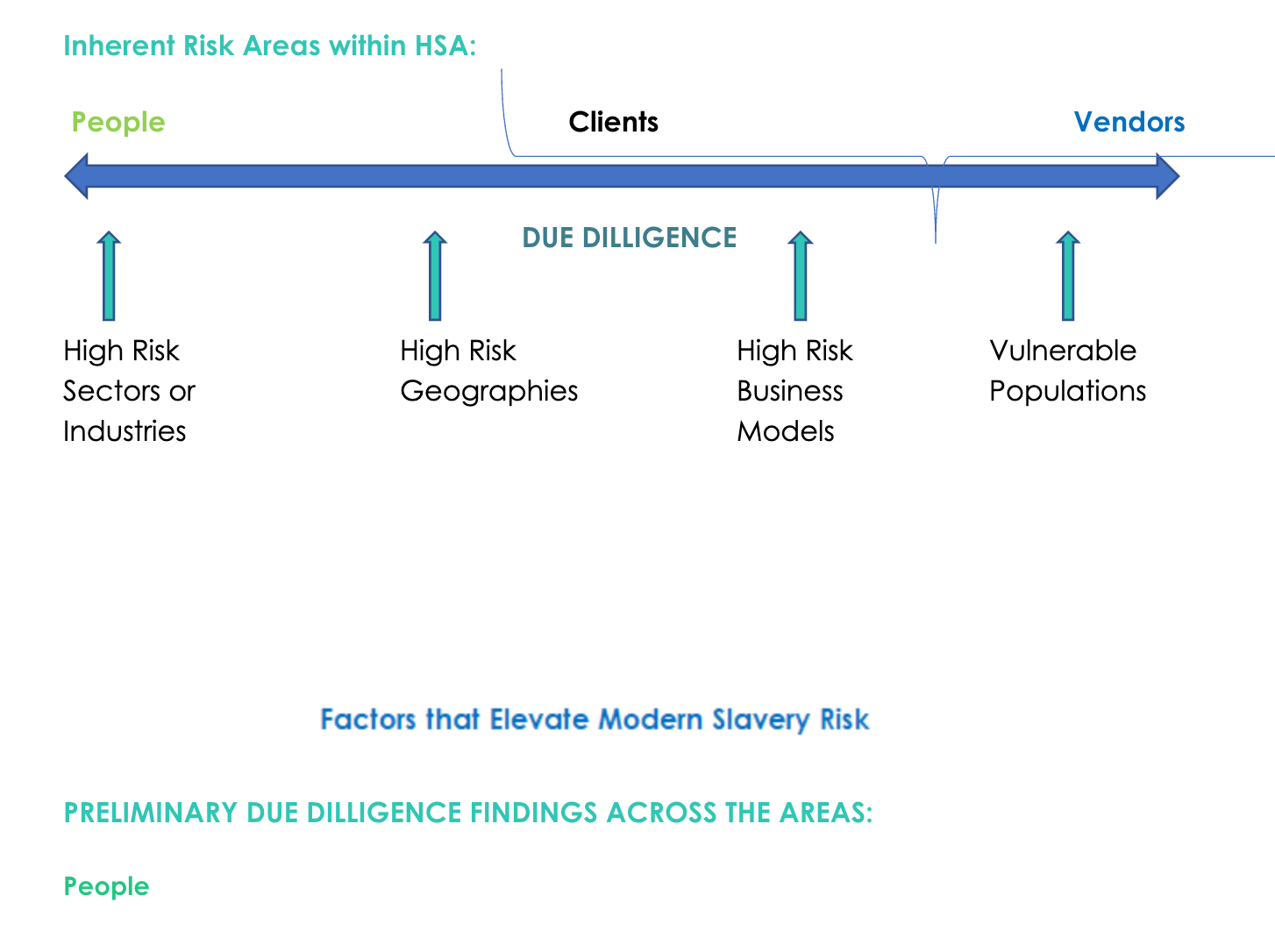
As a professional recruitment nursing agency organisation, we are of the view that the risk of modern slavery in relation to our people is low, due to the level of skills and expertise of our resources and the countries within which our workforce operates.
Clients
HSA’s risk of modern slavery in relation to clients has been categorised as a moderate risk. Although HSA rarely engages with entities that are primarily domiciled outside of Australia in high-risk regions, certain HSA clients may have related entities and operations that are domiciled outside of Australia and that operate in inherently high-risk geographies. Some HSA clients operate in high-risk industries. Policies and procedures in relation to client and engagement acceptance and continuance include a requirement that our engagement teams consider the risks associated with any client or engagement of the firm.
Vendors
We consider HSA’s procurement of products and services, both for internal consumption and on-selling to clients, to carry the highest foreseeable risk of modern slavery. The following complexities explain why vendors are inherently a higher risk and the primary focus of our due diligence:
- The geographical locations within which these vendors operate
- The composition of their workforce
- The business models that are used in their operations.

IMPACT OF THE PANDEMIC
The coronavirus (COVID-19) global pandemic has and is still presenting significant challenges to the global economy. COVID-19 impacted our business, people, clients, and supply chain in FYE 2021 and continues to have an impact:
- Due to the pandemic, the demand for certain categories of spending within HSA, including stationery, cleaning, and travel-related expenses, has decreased.
- The timing of certain planned actions to assess and address modern slavery was delayed due to the pandemic.
- As part of our compliance monitoring and Internal Audit procedures, we have increased the level of scrutiny applied to client on-boarding, to gain further assurance that clients which HSA would ordinarily not do business with are not accepted without appropriate risk assessment.
- Challenges from the pandemic may impact a business' ability to provide security to its workforce. Assessing the likelihood of vulnerable workforces within our supply chain was a key area of focus and continues to be so.
OUR ACTIONS
Step 1 – Analysis of supplier risk profile
Step 2 – Request for supplementary information from suppliers who were higher risk and analysis of their responses
Step 3 – Risk ratings applied to higher risk suppliers supplemented by further information and written assurances from those suppliers
where necessary
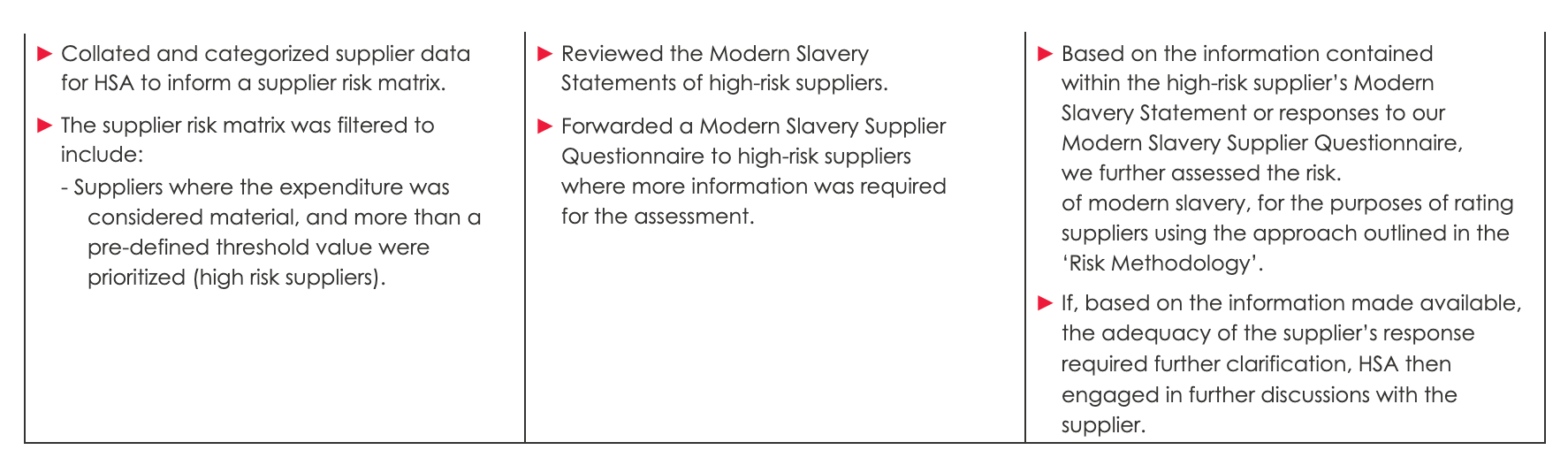
CONFLICT OF INTEREST POLICY
POL030
- INTRODUCTION
Health Staff Global Pty Ltd actively manages real and conflicts of interest that have the potential to negatively impact or influence services. This is part of our commitment to always provide safe and high-quality supports.
Where personal interest comes into conflict with a person’s work-related or volunteering responsibilities. Health Staff Global Pty Ltd exercises good governance, to ensure any conflicts are identified and prevented or resolved.
A conflict of interest may be naturally occurring rather than as an indication of improper activity and all conflicts whether real or possible must be identified, declared, recorded, and managed.
This policy supports Health Staff Global Pty Ltd to Practice Standard 2 Provider Governance and Operational Management (National Quality system).
This policy will outline the rules regarding conflict of interest and the responsibilities of employees and the company in resolving any such discrepancies.
2. SCOPE
This policy applies to Management and all staff including permanent and casual employees, contract workers, temporary agency workers, and volunteers. Anyone working with or for Health Staff Global Pty Ltd is expected to be familiar with this policy and use the approved procedures for responding to real and conflicts of interest.
3. GENERAL PRINCIPALS
Policy Elements
The relationship of Health Staff Global Pty Ltd with its employees should be based on mutual trust. As Health Staff Global Pty Ltd is committed to preserve the interests of people under its employment, it expects them to act only towards its own fundamental interests.
Conflict of interest may occur whenever an employee’s interest in a particular subject may lead them to actions, activities or relationships that undermine the company and may place it to disadvantage.
What is an employee conflict of interest?
This situation may take many different forms that include, but are not limited to, conflict of interest examples:
- Employees’ ability to use their position with the company to their personal advantage.
- Employees engaging in activities that will bring direct or indirect profit to a competitor.
- Employees owning shares of a competitor’s stock.
- Employees using connections obtained through Health Staff Australia for their own private purposes.
- Employees using company equipment or means to support an external business.
- Employees acting in ways that may compromise the company’s legality (e.g. taking bribes or bribing representatives of legal authorities)
The possibility that a conflict of interest may occur can be addressed and resolved before any actual damage is done. Therefore, when an employee understands or suspects that a conflict of interest exists, they should bring this matter to the attention of management so corrective actions may be taken. Supervisors must also keep an eye on potential conflict of interests of their subordinates.
The responsibility of resolving a conflict of interest starts from the immediate supervisor and may reach senior management. All conflicts of interest will be resolved as possible. Senior management has the responsibility of the final decision when a solution cannot be found.
In general, employees are advised to refrain from letting personal and/or monetary interests and external activities come into opposition with the company’s fundamental interests.
What are the three types of conflict of interest?
· Real – where a direct conflict exists between current official duties and existing private interests.
· Apparent – where it appears or could be perceived that private interests are improperly influencing the performance of official duties whether that is the case.
· Potential – where private interests are not but could come into direct conflict with official duties.
CONFLICTS OF INTEREST TO CONSIDER
- NEPOTISM
Nepotism is a situation where people give favourable treatment to the members of the family. This is a personal conflict of interest because it benefits the managers relationship, rather than the business. Health Staff Global Pty Ltd is a family business; therefore, this Conflict of Interest is relevant in this circumstance.
Nepotism is harmful for many reasons, including the following;
Nepotism limits an employer’s opportunities. It can potentially cut off the company’s ability to build teams authentically, promote top talent, develop workplace collaboration, expand shared knowledge, and retain employees overall.
Nepotism destroys organizational leadership. The corrosive act of nepotism often places the wrong people in leadership or subject-matter-expert positions. Poor leadership can hurt the company’s reputation, lead to destructive decision-making, and spark turnover contagion.
Nepotism hurts excellent employees. Nepotism prevents qualified employees or candidates from pursuing professional growth and mapping their career paths properly. They cannot collaborate to produce the best services, products, and policies for their organization.
What strategies Health Staff Global Pty Ltd will use to avoid Nepotism
- Line of Reporting
- Our Organisation chart and structure ensures that family members only report to non-family members.
- Maintain detailed job descriptions to guard against nepotism.
- A job description, including the job title, can support anti-nepotism policies and practices. Maintaining an accurate and detailed job description for each role is one of the best ways to keep team expectations grounded, leadership in check, and an open and communicative platform for all to see. Job descriptions should detail the hard and soft skills, experience and attributes employees need to qualify for any given position within the company.
- Conduct manager (or leadership) training to avoid nepotism.
- Leadership training addresses the concerns of nepotism more than any other step. A direct callout of the practice should include a clear definition of favouritism, a description of what it looks like in the workplace, and a statement that all managers are responsible for avoiding the practice and speaking up when they notice it.
- Promotions & Recruitment Internally
- If you plan to promote from within the company, avoid favouritism toward applicants. The Health Staff Global Pty Ltd Recruitment team's objective data and skills assessments are to reveal which in-house candidate is best for the job.
- Create a transparent, communicative hiring and promotional culture.
- If the hiring process and promotional selection system are openly visible to all, it improves the chance of unity and trust-building within the organisation. It is essential that our hiring and promotional processes are not mysterious. Murky practices will increase the questioning and anxiety around actual or perceived favouritism.
- Develop an HR or senior management approval process for hires and promotions.
- To fortify the phalanx against nepotism, our HR department will make final hiring or promotion-related decisions. HR staff are to have the neutrality and authority to help govern these employment actions. Senior managerial approval is another good step in the hiring process for specific positions and promotions.
Relationships between managers and employees
Conflicts of interest can occur when the managers and employees form romantic relationships. These types of relationships can cause issues with all staff. Changing relationships can cause more issues and create conflict between staff.
- COMPETING BUSINESS
If an employee launches a part-time business in the same industry, a conflict of interest occurs. If the employee's business succeeds, it may reduce the employer's customers and profits. The employee may also use information and contacts from their employment to help their new business succeed. An employee must refer to their contract in this instance to be aware of their responsibilities and potential repercussions.
- EXTERNAL EMPLOYMENT
External Employment can cause a conflict of interest when it occurs in the same sector, an example would be sharing information from one company to another. Employees that are working with 1 or more companies other than Health Staff Australia, must ensure to comply with Health Staff Global Pty Ltd Confidentiality Agreement, in sharing any information with Participants and other employees.
- EMPLOYEE GIFTS
Accepting a gift can cause a conflict of interest as it can show favouritism and influence decisions.
- SELF-DEALING
Taking money from the business for your own personal gain and not for business needs.
- RELATED/ PERSONAL RELATIONSHIPS WITH EMPLOYEES, PARTICIPANTS, SUPPORT COORDINATORS AND DISABILITY ORGANISATIONS
Employees, participants, support coordinators and disability organisations can have a conflict of interest if they are related or have a personal relationship with one another. It is a policy at Health Staff Global Pty Ltd that any relationships should be disclosed to Management. Please also refer to the companies Confidentiality Agreement.
- BENEFITS TO LOVED ONES
The decisions employees make may have positive consequences for their loved ones. For example, being related to a participant and donating to a community organisation that they may be involved in.
- RELIGIOUS OR POLITICAL BELIEFS
Being swayed or making decisions based on religious and political affiliations. Please refer Health Staff Global Pty Ltd Bullying and Harassment Policy for further information.
- SELF-SERVING BIAS
This is the tendency to blame other forces if something bad happens and take responsibility when good things happen.
- PREJUDICE
A prejudice is a prejudgement or prior opinion that a person makes before given the relevant facts and information. When a prejudice takes place, this prejudgement is usually negative or unfavourable. Prejudices are usually based on factors such as a race, religion, gender, sexual orientation, age, disability, social class, education, or language. Please refer Health Staff Global Pty Ltd Bullying and Harassment Policy for further information.
- ATTENTIONAL BIAS
This relates to the practice of paying attention to one thing and ignoring the other. Prioritising participants based on what you think is more important and not validating everyone needs and wants.
- WITH-HOLDING OR INFLUENCING INFORMATION
Not to constrain, influence or direct the decision making of participants as to limit information, opportunities, choice, and control.
- CONFIDENTIALITY
Ensuring information is only shared or disclosed between employees, participants, support co coordinators and disability organisations. Shall not divulge to any person any confidential information concerning the affairs of the Company, or the affairs of participants and the affairs of any third party unless you have permission from the managing director. Please refer to the companies Confidentiality Agreement for further information.
- SUPPORT COORDINATION AND PARTICIPANT FUNDING
As Health Staff Global Pty Ltd supplies, the service of Support coordination to participants, this can be a conflict of interest, in that Health Staff Australia must ensure that Participants receive the correct information and participant funding can be a conflict of interest
To do this, support coordinators & Health Staff Australia must:
- Support coordinators must provide advice that is unbiased and fair to all.
- recommend and provide supports and services appropriate to the needs of the participant
- maintain integrity by declaring and avoiding any real or perceived conflicts of interest
- avoid engaging in, participating in, or promoting sharp practices.
- Maintaining a separation between the service delivery team and the support coordination team where possible;
- Ensuring that information and records of supports participants have received remain confidential;
- Ensuring that participants receive all the information regarding support options under the NDIS;
- Ensuring that the individual is aware of their rights to choose support from a provider that is different to where their support coordinator or plan manager works.
- Communicate honestly and in prompt manner
- Treat everyone with respect and dignity
- Listen to complaints and resolve any issues promptly, ensuring to give the participant information about managing these issues and disagreements and details of the providers cancellation policy.
- Ensure Participants rights are being respected, have freedom of expression, self-determination, and decision-making
- Provide supports I which they are legally required to do so with the National Disability Insurance Scheme Act 2013 and Australian Consumer Law.
- NDIS support coordination Service agreement will need to sign before starting with Support Coordination Support.
Health Staff Global Pty Ltd compliance obligations:
- make claims for payments that are correct and truthful.
- only provide and charge for supports that are in line with a participant's plan.
- identify, declare, and manage any conflict of interest including disclosing this information to the participant.
Note: The same principles apply to Health Staff Global Pty Ltd regarding its clients. When applicable, we are committed to not offer services or form partnerships with companies who are in direct competition with one of our existing clients.
Procedure when onboarding a new Participant in offering our Support Coordination Services:
- Inform the Participant/Advocate of their options regarding Support Coordination – supply link to Provider Finder Tool on the NDIS website: Provider finder | NDIS
- If the participant/advocate decides to employ Health Staff Global Pty Ltd in the Support Coordination services, supply and explain the Support Coordination Service Agreement.
DISCIPLINARY CONSEQUENCES
In cases when a conflict of interest is deliberately concealed or when a solution cannot be found, disciplinary action may be invoked up to and including termination.
RECORD RETENTION AND DATA POLICY
POL031
- INTRODUCTION
The purpose of this Policy is to ensure that necessary records and documents of are adequately protected and maintained and to ensure that records that are no longer needed by Health Staff Global Pty Ltd or are of no value are discarded at the proper time. This Policy is also for the purpose of aiding employees in understanding their obligations in retaining electronic documents - including e-mail, Web files, text files, sound and movie files, PDF documents, and all Microsoft Office or other formatted files.
2. SCOPE
This policy applies across the organisation of Health Staff Global Pty Ltd and all workplaces under our control.
3. CONTENT
This Policy represents Health Staff Global Pty Ltd policy regarding the retention and disposal of records and the retention and disposal of electronic documents.
Administration
The Executive Assistant is the officer in charge of the administration of this Policy and the implementation of processes and procedures to ensure that the Record Retention Schedule is followed. The Administrator is also authorized to: make modifications to the Record Retention Schedule from time to time to ensure that it is in compliance with local, state and federal laws and includes the appropriate document and record categories for Health Staff Global Pty Ltd; monitor local, state and federal laws affecting record retention; annually review the record retention and disposal program; and monitor compliance with this Policy.
Applicability
This Policy applies to all electronic records generated during operation, including both original documents and reproductions.
The Record Retention Schedule is organized as follows:
SECTION TOPIC
A. Accounting and Finance
B. Executive Leadership and Corporate Records
C. Meetings and Correspondence
D. Insurance records
E. Human resources
F. Participant/Client Records
H. Legal Files and Papers
I. Miscellaneous
J. Quality
A. ACCOUNTING AND FINANCE
RECORD TYPE RETENTION PERIOD
Accounts Payable ledgers and schedules 7 years
Accounts Receivable ledgers and schedules 7 years
Annual Audit Reports and Financial Statements Permanent
Annual Audit Records, including work papers and other documents that relate to the audit 7 years after completion of audit
Annual Plans and Budgets 2 years
Bank Statements and Cancelled Cheques 7 years
Employee Expense Reports 7 years
General Ledgers Permanent
Interim Financial Statements 7 years
Client & Participant Financial Records 7 years
Client Management & Participant Records 7 years
Notes Receivable ledgers and schedules 7 years
Investment Records 7 years after sale of investment
Credit card records (documents showing customer credit card number) 2 years
1. Credit card record retention and destruction
A credit card may be used for business related purchases.
All records showing customer credit card number must be locked in a desk drawer or a file cabinet when not in immediate use by staff.
If it is determined that information on a document, which contains credit card information, is necessary for retention beyond 2 years, then the credit card number will be cut out of the document.
Suspension of Record Disposal in Event of Litigation or Claims
In the event that Health Staff Global Pty Ltd is served with any subpoena or request for documents or any employee becomes aware of a governmental investigation or audit concerning Health Staff Global Pty Ltd or the commencement of any litigation against or concerning the company, such employee shall inform the Administrator and any further disposal of documents shall be suspended until shall time as the Administrator, with the advice of counsel, determines otherwise. The Administrator shall take such steps as is necessary to promptly inform all staff of any suspension in the further disposal of documents.
B. CONTRACTS
RECORD TYPE RETENTION PERIOD
Contracts and Related Correspondence (including any proposal that resulted in the contract and all other supportive documentation)
7 years after expiration or termination
Participant Contracts and Service Agreements
7 years after expiration or termination
C. CORPORATE RECORDS
RECORD TYPE RETENTION PERIOD
Corporate Records (minute books, signed minutes of the Board and all committees, corporate seals, articles of incorporation, bylaws, annual corporate reports) Permanent
Licenses and Permits Permanent
D. INSURANCE RECORDS
RECORD TYPE RETENTION PERIOD
Claims file Permanent
Audits and adjustments Permanent
Policies Permanent
E. HUMAN RESOURCES
RECORD TYPE RETENTION PERIOD
Employee personnel records- payroll, TFN, Superannuation, PAYG
Termination + 7 years
Licenses and Permits
Termination + 7 years
Timesheets 2 years
F. PARTICIPANT/CLIENT RECORDS
RECORD TYPE RETENTION PERIOD
Participant files 7 Years post last contact
Client information files 7 Years post last contact
H. LEGAL FILES AND PAPERS
RECORD TYPE RETENTION PERIOD
ATO and tax records Permanent
Licenses and Permits Permanent
I. MISCELLANEOUS
RECORD TYPE RETENTION PERIOD
Work Health and Safety 5 years
Notifiable incidents 5 years
Health monitoring records 7 years post last contact
J. QUALITY ASSURANCE
RECORD TYPE RETENTION PERIOD
Audit reports and results 3 years
Corrective actions 3 years
Management review minutes 3 years
Suppliers’ assessment records 3 years
- DISPOSAL OF RECORDS
Records are only to be disposed once expired in reference to Table above.
Below outlines the Roles and Responsibilities of the disposal of records and the disposal instructions.
ROLES RESPONSIBILITIES
Executive Management Team
- Authorising the destruction of records in their relation to their departments (Finance, Operations etc)
- Ensuring regular and systematic disposal of records in accordance with these procedures.
- Responsible for monitoring compliance with records management legislation, policies, and procedures within their organisational areas.
- Providing advice on the disposal of records, particularly how long records should be kept.
Administration Team
Disposing records aligning to the table below & with Executive Management Team direction
TYPE OF RECORD
DISPOSAL INSTRUCTIONS
Paper Records
Placement into Secure Shredding bins supplied and maintained by Flagstaff
Digital Records
Deletion of Cloud-based storage – SharePoint, and deletion from local drives
Where necessary destruction of External Drives through VITG – our IT Service Provider
- RESPONSIBILITIES
Managers and Supervisors must:
- Implement and review this policy;
- Inform all workers of this policy;
Workers must:
- Comply with the rules of this policy
COMPLAINT MANAGEMENT POLICY
POL032
- INTRODUCTION
The purpose of this Policy is to ensure that necessary records and documents of are adequately protected and maintained and to ensure that records that are no longer needed by Health Staff Global Pty Ltd or are of no value are discarded at the proper time. This Policy is also for the purpose of aiding employees in understanding their obligations in retaining electronic documents - including e-mail, Web files, text files, sound and movie files, PDF documents, and all Microsoft Office or other formatted files.
- SCOPE
This policy applies across the organisation of Health Staff Global Pty Ltd and all workplaces under our control.
- CONTENT
This Policy represents Health Staff Global policy regarding the retention and disposal of records and the retention and disposal of electronic documents.
Administration
The Executive Assistant is the officer in charge of the administration of this Policy and the implementation of processes and procedures to ensure that the Record Retention Schedule is followed. The Administrator is also authorized to: make modifications to the Record Retention Schedule from time to time to ensure that it is in compliance with local, state and federal laws and includes the appropriate document and record categories for Health Staff Global; monitor local, state and federal laws affecting record retention; annually review the record retention and disposal program; and monitor compliance with this Policy.
Applicability
This Policy applies to all electronic records generated during operation, including both original documents and reproductions.
The Record Retention Schedule is organized as follows:
SECTION TOPIC
A. Accounting and Finance
B. Executive Leadership and Corporate Records
C. Meetings and Correspondence
D. Insurance records
E. Human resources
F. Client management & Participant Records
H. Legal Files and Papers
I. Miscellaneous
J. Payroll Documents
K. Programs & Services Records
A. ACCOUNTING AND FINANCE
RECORD TYPE
RETENTION PERIOD
Accounts Payable ledgers and schedules
7 years
Accounts Receivable ledgers and schedules
7 years
Annual Audit Reports and Financial Statements
Permanent
Annual Audit Records, including work papers and other documents that relate to the audit
7 years after completion of audit
Annual Plans and Budgets
2 years
Bank Statements and Cancelled Cheques
7 years
Employee Expense Reports
7 years
General Ledgers
Permanent
Interim Financial Statements
7 years
Client & Participant Financial Records
7 years
Client Management & Participant Records
7 years
Notes Receivable ledgers and schedules
7 years
Investment Records
7 years after sale of investment
Credit card records (documents showing customer credit card number)
2 years
1. Credit card record retention and destruction
A credit card may be used for business related purchases.
All records showing customer credit card number must be locked in a desk drawer or a file cabinet when not in immediate use by staff.
If it is determined that information on a document, which contains credit card information, is necessary for retention beyond 2 years, then the credit card number will be cut out of the document.
Suspension of Record Disposal in Event of Litigation or Claims
In the event that Health Staff Global is served with any subpoena or request for documents or any employee becomes aware of a governmental investigation or audit concerning Health Staff Global or the commencement of any litigation against or concerning the company, such employee shall inform the Administrator and any further disposal of documents shall be suspended until shall time as the Administrator, with the advice of counsel, determines otherwise. The Administrator shall take such steps as is necessary to promptly inform all staff of any suspension in the further disposal of documents.
B. CONTRACTS
RECORD TYPE RETENTION PERIOD
Contracts and Related Correspondence (including any proposal that resulted in the contract and all other supportive documentation)
7 years after expiration or termination
Participant Contracts and Service Agreements
7 years after expiration or termination
C. CORPORATE RECORDS
RECORD TYPE RETENTION PERIOD
Corporate Records (minute books, signed minutes of the Board and all committees, corporate seals, articles of incorporation, bylaws, annual corporate reports)
Permanent
Licenses and Permits
Permanent
- DISPOSAL OF RECORDS
Records are only to be disposed once expired in reference to Table A, B and C.
Below outlines the Roles and Responsibilities of the disposal of records and the disposal instructions.
ROLES
RESPONSIBILITIES
Executive Management Team
- Authorising the destruction of records in their relation to their departments (Finance, Operations etc)
- Ensuring regular and systematic disposal of records in accordance with these procedures.
- Responsible for monitoring compliance with records management legislation, policies, and procedures within their organisational areas.
- Providing advice on the disposal of records, particularly how long records should be kept.
Administration Team
Disposing records aligning to the table below & with Executive Management Team direction
TYPE OF RECORD
DISPOSAL INSTRUCTIONS
Paper Records
Placement into Secure Shredding bins supplied and maintained by Flagstaff
Digital Records
Deletion of Cloud-based storage – SharePoint, and deletion from local drives
Where necessary destruction of External Drives through VITG – our IT Service Provider
- RESPONSIBILITIES
Managers and Supervisors must:
- Implement and review this policy;
- Inform all workers of this policy;
Workers must:
- Comply with the rules of this policy
ATTENDANCE AND ABSENTEEISM POLICY
POL034
- INTRODUCTION
Punctual and regular attendance is an essential responsibility of each employee of Health Staff Global Pty Ltd (the Company).
Employees are expected to report to work as scheduled and remain at work for their entire working day. Late arrival, early departure or other absences from scheduled hours are disruptive and should be avoided to promote the efficient operation of the Company and eliminate unnecessary burden on fellow colleagues.
While the Company appreciates that at times there will be instances where employees are unable to attend their scheduled shift on time, or at all, due to personal reasons, the purpose of this policy is to outline the Company’s expectations regarding what employees are required to do if they are late to or absent from work.
- SCOPE
This policy applies across the organisation of Health Staff Global Pty Ltd and all workplaces under our control.
- CONTENT
Attendance
Regular attendance is essential to the efficient workflow and productivity of the Company.
An employee who does not attend work will forgo pay for the duration of the non-attendance unless the non-attendance is authorised paid leave.
Absence
Depending on the circumstances of the absence, the leave of absence may be approved, denied, paid or unpaid.
An approved absence includes an absence on account of personal/carer’s leave.
A denied absence includes an absence which an employee has no valid reason for. This may include, amongst other reasons:
I. waking up late;
ii. traffic delays;
iii. unable to find appropriate clothing to wear; or
iv. misplacement of house/car keys.
A paid absence includes an absence on account of personal/carer’s leave where the employee has sufficient leave accrued to cover the absence.
An unpaid absence includes an absence on account of personal/carer’s leave where the employee does not have sufficient leave accrued to cover the absence or where an application for paid leave has been denied.
Notification Requirements
In circumstances where an employee is running late to their scheduled shift or is unable to attend work at all, the Company expects that all employees adhere to the following notification procedure:
- provide notice as soon as is practicable by telephoning their manager directly; or
- if, and only if, their manager does not pick up the call, the employee should leave a message with an authorised representative of the Company and send a follow up email/text message to their manager advising the same.
Documentary Requirements
In circumstances where an employee is absent from work on account of authorised personal/carer’s leave, the Company may request that documentary evidence in relation to the absence is provided.
Abandonment of Employment
Abandonment of employment usually arises in circumstances where an employee is absent from work without a reasonable excuse for an unreasonable period without having communicated to the Company any reason for the absence.
Unless a modern award provides otherwise, in circumstances where an employee has been absent from work for five (5) or more consecutive days, and the Company has tried to unsuccessfully contact the employee on at least five (5) or more occasions, the employee will be deemed to have abandoned their employment.
In such situations, the employee’s employment will terminate for reasons of abandonment as from the last day they presented for work.
Disciplinary Action
The Company reserves its right to commence disciplinary action in circumstances where:
if. the employee presents to work in a tardy fashion without a reasonable excuse on more
than one occasion;
ii. the employee does not follow the notification requirements as set out in this policy; or
iii. the employee does not supply appropriate evidence, including medical evidence in
support of an absence when requested by the Company.
Breach of Policy
All employees are required to comply with this policy as amended from time to time.
Any breach of this policy may result in disciplinary action, up to and including termination of employment with the Company.
Variations
The Company reserves the right to vary or replace this policy at any time.
Definitions: Absenteeism means the frequent absence of an employee without a valid reason.
- Roles and responsibilities
Responsibilities of Manager
Managers are responsible and accountable for:
I. monitoring their employees’ attendance;
ii. facilitating discussions with employees where there is a pattern of Absenteeism;
iii. ensuring appropriate measures are in place to assist employees in achieving optimal
work efficacy; and
iv. raising concerns to higher management in instances where it is believed an underlying health issue may be the cause of the employees’ Absenteeism.
Responsibilities of Employees
All employees are responsible and accountable for:
I. ensuring, they present to work as scheduled;
ii. pre-planning their journey into work to take into consideration traffic and/or public transport concerns to ensure timely arrival to work;
iii. notifying the Company in accordance with the requirements outlined in this policy in circumstances where they will be late to work or cannot attend work at all; and
iv. ensuring appropriate evidence, including medical evidence, is provided to the Company in accordance with the requirements outlined in this policy.
FLEXIBLE WORKING POLICY
POL034
- INTRODUCTION
Health Staff Global Pty Ltd ("the Company") recognises that employees will have differing life situations outside of the workplace, some of which may conflict with conventional work arrangements and as a result may request flexibility in the terms of their employment. The Company promotes a flexible work environment that allows employees to achieve a genuine balance in work, family, and personal responsibilities.
The Company is committed to considering and accommodating flexible work arrangements on a fair and reasonable assessment of individual employee circumstances, subject to the Fair Work Act 2009 (Cath) (“Act”) and the operational requirements of the Company.
- SCOPE
This policy applies to all permanent employees of the Company who have completed at least 12 months of continuous service with the Company.
This policy also applies to casual employees who have been employed by the Company on a regular and systematic basis for at least 12 months, and who have a reasonable expectation of continuing employment by the Company.
- CONTENT
Eligibility
The following employees have a right to make a flexible working request to the Company:
i. parents, or employees who have responsibility for the care, of a child who is of school age or younger;
ii. carers;
iii. employees with a disability.
iv. employees aged 55 years or older.
v. pregnant employees.
vi. employees experiencing family and domestic violence from a member of the employee's family; and
vii. employees who provide care or support to a member of the employee's immediate family, or a member of the employee's household, who requires care or support because the member is experiencing family and domestic violence from the member's family.
Flexible Working Requests
An eligible employee has a right to make a request for a flexible working arrangement which may include changes in:
i. hours of work (e.g. reduction in hours or changes to start and finish times);
ii. patterns of work (e.g. job sharing); or
iii. location of work.
Procedure for making a request
To enable the Company to appropriately consider a request for flexible working arrangements, an eligible employee must:
i. makes the request in writing;
ii. set out the details of the change sought and the reasons for the change;
iii. give no less than four weeks’ notice;
iv. confirm that the basis upon which they are eligible to make such a request, for example parental responsibility or disability;
v. specifies the proposed effective date; and
vi. state whether a previous application has been made and if so when.
If the above information is omitted or insufficient, the Company is not obliged to consider the application and can request the employee resubmit their application.
Responsibility of the Company
Upon receipt of a flexible working request, the Company will:
i. discusses the request with the employee;
ii. genuinely try to reach an agreement with the employee about making changes to the employee’s working arrangements that would accommodate the employee’s circumstances, including options that are not precisely what the employee has requested but which accommodate the employee’s needs to some extent;
iii. provide the employee with a written response within 21 days; and
iv. if the Company has refused to accept the request, provide reasons as to why.
The Company may only refuse a request if the Company has:
i. discussed the request with the employee in line with the Company’s obligations above;
ii. genuinely tried to reach an agreement with the employee about making changes to the employee’s working arrangements that would accommodate the employee’s circumstances;
iii. been unable to reach an agreement with the employee;
iv. had regard to the consequences of the refusal for the employee; and
v. the refusal is based on reasonable business grounds.
If the request is refused the Company will provide the employee with a written response:
i. providing the reasons for the refusal, including the business ground or grounds for the refusal and how the ground or grounds apply;
ii. setting out other changes to the employee’s working arrangements that the Company is willing to make, and which would accommodate, to any extent, the employee’s circumstances, or saying that there are no such changes the employer is willing to make; and
iii. providing information on the despite resolution provisions in the Fair Work Act 2009.
Reasonable business grounds may include that:
i. the new working arrangements requested would be too costly for the Company;
ii. there is no capacity to change the working arrangements of other employees to accommodate the request;
iii. it would be impractical to change the working arrangements of other employees, or recruit new employees, to accommodate the request;
iv. iv. the new working arrangements requested would result in a significant loss in efficiency or productivity; and
v. the new working arrangements requested would be likely to have a significant negative impact on customer service.
If the request is accepted the Company may specify a review date of the flexible work arrangement and make the approval subject to certain conditions including, however not limited to, changes in supervision, monitoring, or other systems to ease the request.
Assessing a Flexible Working Request
A flexible work request will be considered on a case-by-case basis considering the employee’s individual circumstances and the Company’s operational requirements.
Flexible work options
Flexible working arrangements which the Company may consider include:
i. permanent part-time work;
ii. variations to start and finish times;
iii. job sharing;
iv. working from home arrangements; and
v. compressed hours (where the employee works additional daily hours to provide for a shorter working week or fortnight).
The above list is not an exhaustive list, and other options may be agreed.
Nothing in this list entitles an employee to a particular arrangement. The appropriateness of each will depend on the operational requirements of the Company.
Employees utilising flexible work practices will be treated no less favourably than any other employee.
Flexible working arrangements end automatically on the date agreed between the Company and the employee or they can be terminated by the employee with reasonable notice or by the
Company with reasonable notice and on reasonable business grounds.
Resources and further information
Flexible working arrangements are provided for by the National Employment Standards and can be found in section 65 or the Fair Work Act 2009.
Breach of policy
Any employee who is found to have breached this policy will be subject to disciplinary action, up to and including termination of employment.
Variation
This policy does not form part of any employee's contract of employment. The Company may vary, replace, or terminate this policy from time to time.
RESPONSIBILITIES
Managers and Supervisors must:
- Implement and review this policy;
- Inform all workers of this policy;
Workers must:
- Comply with the rules of this policy
Complaint Handling Policy
POL035
1. Purpose
The purpose of this policy is to ensure that all staff at Health Staff Australia handle complaints in a professional, consistent, fair, and timely manner.
This policy provides staff with guidance on:
- How to respond to and resolve complaints,
- Their roles and responsibilities in the complaint handling process, and
- How to learn from complaints to improve our services and workplace culture.
2. Scope
This policy applies to all employees, contractors, and volunteers of Health Staff Australia.
It covers complaints received from:
- Clients and their representatives,
- Members of the public,
- Colleagues or other internal staff, and
- External agencies relating to staff conduct or service delivery.
This policy does not cover:
- Staff grievances, which are managed under the Grievance Policy.
- Public interest disclosures, which are handled under the Whistleblower or Internal Reporting Policy.
All complaints can be made by email to:
📧
complaints@healthstaff.au
3. Definitions
Term
Definition
Complaint
An expression of dissatisfaction made to or about Health Staff Australia, its services, staff, or complaint handling, where a response or resolution is expected or required.
Feedback
A general comment or suggestion that does not require a formal response.
Complainant
Any person or organisation making a complaint.
Staff Grievance
A formal concern raised by an employee about another staff member or workplace issue.
Complaint Management System
The processes, procedures, and tools used to manage complaints within the organisation.
4. Staff Responsibilities
All Staff Must:
- Treat every complaint seriously and with respect.
- Record and report complaints promptly according to procedure.
- Maintain confidentiality and handle information sensitively.
- Refer complex or unresolved complaints to their line manager or the Complaints Officer.
- Never ignore or dismiss a complaint.
- Direct all complaints received via email to complaints@healthstaff.au if they are not able to resolve the issue at first contact.
Managers Must:
- Support staff to manage complaints effectively.
- Ensure complaints are recorded, investigated, and resolved promptly.
- Identify any patterns or systemic issues.
- Encourage a positive and open attitude toward feedback.
Managing Director / CEO Must:
- Promote a culture that values complaints as opportunities for improvement.
- Ensure staff receive training and support in complaint handling.
- Review complaint trends and outcomes to identify service improvement opportunities.
5. Guiding Principles
Health Staff Australia is committed to the following principles:
- Fairness and Respect – All parties will be treated impartially and with courtesy.
- Accessibility – Information on how to make a complaint is publicly available and easy to understand.
- Timeliness – Complaints will be acknowledged and resolved promptly.
- Confidentiality – Information about complaints will be kept private and shared only when necessary.
- Accountability – Staff are responsible for managing and reporting complaints in line with policy.
- Continuous Improvement – Lessons from complaints are used to enhance services and staff performance.
6. Complaint Handling Process
Step 1: Receive and Record
- Staff receiving a complaint must listen respectfully, clarify the issue, and record key details.
- All complaints should be emailed to complaints@healthstaff.au for logging in the complaint register.
Step 2: Acknowledge
- The Complaints Officer (or manager) will acknowledge the complaint within 5 business days.
- The acknowledgement will include:
- Confirmation of receipt,
- A brief outline of the process, and
- An estimated timeframe for resolution.
Step 3: Assess and Investigate
- Assess the seriousness, potential risk, and scope of the complaint.
- Gather relevant information and, where necessary, interview involved parties.
- Escalate serious or sensitive complaints to senior management.
Step 4: Respond
- Provide a written or verbal response explaining:
- The findings,
- Actions taken, and
- Options for review or appeal (if applicable).
- The response should come from the Complaints Officer via complaints@healthstaff.au.
Step 5: Close and Record
- Confirm that the complainant is satisfied (where possible).
- Record the outcome, any corrective actions, and any lessons learned.
- All documentation is stored securely in the complaint management system.
7. Confidentiality and Privacy
All staff must protect the identity of complainants and those involved in the complaint process.
Information must be managed in accordance with the Privacy Act 1988 (Cth) and the Australian Privacy Principles (APPs).
8. Unreasonable Complainant Conduct
Health Staff Australia will manage unreasonable behaviour by complainants (e.g. aggression, persistent or abusive contact) in accordance with the Ombudsman’s Managing Unreasonable Complainant Conduct Model Policy (2012). Staff will be supported in these situations.
9. Learning and Continuous Improvement
- Complaint data will be analysed quarterly to identify trends and training needs.
- Improvements arising from complaint reviews will be implemented and shared with relevant teams.
- Positive complaint handling will be recognised and rewarded.
10. Contact Information
All complaints, concerns, and formal feedback should be directed to:
📧
complaints@healthstaff.au
Health Staff Australia – Complaints Officer
CODE OF CONDUCT POLICY
POL036
- INTRODUCTION
All employees of Health Staff Global Pty Ltd ("the Company") are entitled to take leave in accordance with relevant legislation and the provisions of this policy.
This policy is intended to provide employees with an understanding of their leave entitlements and the process of application for and approval to take leave.
- SCOPE
This policy applies across the organisation of Health Staff Global Pty Ltd and all workplaces under our control.
- CONTENT
Definitions
NES means the National Employment Standards in the Fair Work Act 2009 (Cath).
Immediate Family Member means the following members of an employee's immediate family:
I. a spouse, de facto partner, child, parent, grandparent, grandchild, or sibling of the employee;
ii. a child, parent, grandparent, grandchild or sibling of the employee’s spouse or de facto partner.
Family and Domestic Violence means violent, threatening, or other abusive behaviour by a Close Relative of an employee that seeks to coerce or control the employee and that causes the employee harm or to be fearful.
Close Relative of an employee means a person who is an Immediate Family Member of the employee is a current or former intimate partner of the employee or is related to the employee according to Aboriginal or Torres Strait Islander kinship rules.
Annual Leave
Entitlement
Full-time and part-time employees will accrue annual leave progressively during a year of service according to the employee's ordinary hours of work in accordance with the NES.
Full-time employees who are not performing shift work will be entitled to a maximum of 4 weeks annual leave during each year of service. Part-time employees will accrue a pro rata amount of annual leave.
Full-time employees who meet the definition of a shift worker may be entitled to a maximum of 5 weeks annual leave during each year of service in accordance with the relevant legislation and any applicable industrial instrument.
An employee's entitlement to annual leave will accumulate from year to year.
Casual employees are not entitled to annual leave.
Taking Annual Leave
Annual leave must be taken at a time suitable to both the employee and the Company.
When an employee proposes to take a period of annual leave, the time and date of such leave must be authorised by the Company. Authorisation by the Company is subject to the operational requirements of the Company.
Travel arrangements must not be made until the request to take annual leave has been authorised by the Company. The Company will not be held responsible for any costs incurred by the employee if travel arrangements are made before seeking authorisation and the request to take annual leave is subsequently not authorised.
Excessive Annual Leave
The Company may, in accordance with the relevant legislation and any applicable industrial instrument, direct the employee to take a period of accrued and excessive annual leave.
Public Holidays
In the event a public holiday occurs during a period of annual leave taken by an employee (who is a permanent employee), the public holiday will not be counted as an annual leave day.
Personal/Carer’s Leave during Annual Leave
If an employee becomes entitled to take personal/carer’s leave because of illness or injury during a period of annual leave, the employee may apply to their manager to have their annual leave reversed and to instead take a period of personal/carer’s leave.
Employees requesting re-credits of their annual leave because of an illness or injury during a period of annual leave may be required to provide documentary evidence in accordance with this policy and the NES.
Cashing out of Annual Leave
The Company may enter into a written agreement with an employee to allow the employee to cash out a portion of their accrued annual leave in accordance with the relevant legislation and any applicable industrial instrument.
Personal/Carer’s Leave
Entitlement
Full-time and part-time employees will accrue personal/carer’s leave progressively during a year of service according to the employee's ordinary hours of work in accordance with the NES.
Full-time employees will be entitled to a maximum of 10 days paid personal/carer’s leave during each year of service.
Part-time employees will accrue a pro rata amount of paid personal/carer’s leave.
An employee's entitlement to paid personal / carer’s leave will accumulate from year to year but will not be paid out on termination of the employee’s employment with the Company.
Casual employees are not entitled to paid personal / carer’s leave but may take up to 2 days of unpaid carer’s leave in accordance with the NES.
Taking personal/carer’s leave:
Personal/carer’s leave may be used where:
i. the employee is not fit for work because of a personal illness, or personal injury, affecting the employee; or
ii. to provide care or support to an Immediate Family Member, or a member of the employee's household, who requires care or support because of a personal illness, or personal injury, affecting the member; or an emergency affecting the member
Notification Requirements
An employee who requests a period of personal/carer’s leave must provide notice as soon as practicable and provide details on the period or expected period of the absence.
In notifying the Company, the employee must telephone their manager and in cases where the manager is unavailable, leave a message and return telephone number.
Documentary Requirements
If the Company requires an employee to provide documentary evidence in relation to a period of personal/carer’s leave taken (or to be taken), the employee must provide the Company evidence that would satisfy a reasonable person that the personal/carer’s leave is taken for a
permitted reason. This may include but is not limited to a medical certificate or statutory declaration.
Unpaid Carer's Leave
An employee may take up to 2 days of unpaid carers' leave per permissible occasion if the employee satisfies the requirements to take paid carer’s leave and the employee:
I. has exhausted their entitlement to paid carer’s leave; or
ii. the employee is a casual employee;
Family and Domestic Violence Leave
Entitlement
All employees, including casual employees, may be eligible to take up to 10 days paid family and domestic violence leave in a 12-month period in accordance with the Fair Work Act 2009 (Cath).
All employees, including casual employees, will receive payment at their full rate of pay for the hours they would have worked had they not been on family and domestic violence leave. For a casual employee, their full rate of pay is inclusive of the casual loading.
An employee may take paid leave to deal with Family and Domestic Violence if the employee:
I. is experiencing Family and Domestic Violence; and
ii. needs to do something to deal with the impact of the Family and Domestic Violence; and
iii. it is impractical for the employee to do that thing outside their ordinary hours of work.
The reasons for which an employee may take family and domestic violence leave include deciding for the safety of the employee or the safety of a Close Relative (including relocation), attending urgent court hearings, or accessing police services.
Notification Requirements
An employee must give the Company notice of the taking of family and domestic violence leave as soon as practicable and provide details on the period or expected period of the absence.
Documentary Requirements
If the Company requires an employee to provide documentary evidence in relation to a period of family and domestic violence leave, the employee must provide the Company evidence that would satisfy a reasonable person that the leave is taken to deal with Family and Domestic
Violence and it is impractical for the employee to do that thing outside their ordinary hours of work.
Depending on the circumstances such evidence may include a document issued by the police service, a court or a family violence support service, or a statutory declaration.
Confidentiality
The Company shall, as far as is reasonably practicable, take steps to ensure information concerning any notice an employee has given, or evidence an employee has provided in relation to a period of family and domestic violence leave is treated confidentially.
Nothing in this policy prevents the Company from disclosing information provided by an employee if the disclosure is required by an Australian law or is necessary to protect the life, health or safety of the employee or another person.
Compassionate Leave
Entitlement
All employees, including casual employees, may be eligible to take a period of up to 2 days of compassionate leave for each occasion when an Immediate Family Member, or a member of the employee's household:
I. contracts or develops a personal illness that poses a serious threat to his or her life; or
ii. sustains a personal injury that poses a serious threat to his or her life; or
iii. dies; or
iv. a child is stillborn, where the child would have been a member of the employee’s Immediate Family, or a member of the employee’s household, had the child been born alive; or
v. the employee, or the employee’s current spouse or de facto partner has a miscarriage.
An employee who is entitled to a period of compassionate leave for a particular permissible occasion is entitled to take the compassionate leave as:
I. a single, unbroken period of 2 days; or
ii. 2 separate periods of 1 day each; or
iii. any separate periods to which the employee and the Company agree.
An employee who is entitled to a period of compassionate leave because an Immediate Family Member, or a member of the employee's household, has contracted or developed a personal illness, or sustained a personal injury, is entitled to start to take the compassionate leave at any time while the illness or injury persists.
Payment
If a full time or part time employee takes a period of compassionate leave, the leave will be paid at the employee’s base rate of pay in accordance with the NES.
Casual employees are not entitled to paid compassionate leave but may take a period of compassionate leave on an unpaid basis.
Notification Requirements
An employee who requests a period of compassionate leave must provide notice as soon as practicable and provide details on the period or expected period of the absence.
Documentary Requirements
If the Company requires an employee to provide documentary evidence in relation to a period of compassionate leave, the employee must provide the Company evidence that would satisfy a reasonable person of the personal illness, sustained personal injury or death.
Community Service Leave
Entitlement
All employees, including casual employees, may be eligible to take up to 10 days of community service leave in accordance with the NES or any applicable state or territory legislation, whichever is more favourable to the employee.
Community service leave may be taken for voluntary emergency management activities with a recognised emergency management body and/or if required to attend for jury duty (including attendance for jury selection).
Payment
Community service leave is unpaid, provided that full time and part time employees (not casual employees) will be entitled to be paid at the employee’s base rate of pay less any amounts paid to the employee by the Court where the community service leave is taken to allow the
employee to attend for jury duty.
Notification Requirements
An employee who wants to take a period of community service leave must provide notice as soon as practicable and provide details on the period or expected period of the absence.
Documentary Requirements
If the Company requires an employee to provide documentary evidence in relation to a period of community service leave, the employee must provide the Company evidence that would satisfy a reasonable person that the absence is because the employee has been or will be
engaging in an eligible community service activity.
Where the community service leave is taken to allow the employee to attend for jury duty, the Company may also request evidence as to the steps taken by the employee to obtain any amount of jury service pay and of the total amount (even if it is a nil amount) of jury service pay
that has been paid, or is payable, to the employee in accordance with the NES.
Long Service Leave
An employee may be entitled to long service leave in accordance with applicable state or territory legislation.
An employee who wants to take a period of long service leave must provide notice as soon as practicable and provide details on the period or expected period of the absence.
Parental Leave
Please refer to the Company’s Parental Leave Policy.
Breach of this policy
All employees are required to comply with this policy as amended, varied, or replaced from time to time. This policy does not form part of any employee’s contract of employment.
Any employee who is found to have breached this policy may be subject to disciplinary action, up to and including termination of employment.
Variation
The Company may amend, vary, or replace this policy at any time.
- Roles and responsibilities
Responsibilities of Manager
Managers are responsible and accountable for:
i. monitoring their own and employees’ leave;
ii. adhere to the policy
Responsibilities of Employees
All employees are responsible and accountable for:
i. adhering to the policy
LEAVE POLICY
POL037
- Introduction
In accordance with the Basic Conditions of Employment Act, section 22, employees are entitled to 30days paid sick leave in every 3-year cycle, commencing on the first day of employment.
During the first 6 months of employment, the employee is entitled to 1 day paid sick leave for every 26 days (about 3 and a half weeks) worked. (BCEA SECTION 22 (3))
On the first working day of month number 7, the balance of the 30-day entitlement becomes available to the employee.
The employee is entitled to use the available sick leave days at any time during the ensuing 3 years, for genuine illness.
Should the employee utilize all the available sick leave before the expiry of the 3-year cycle, then that employee has no sick leave available for the balance of that 3-year cycle.
Should the employee require more sick leave before the next leave cycle, that requirement must be taken as unpaid leave, or at the employee's request, annual leave may be used, except as provided elsewhere herein.
- Proof of incapacity
The employer is entitled to request proof of incapacity on those occasions where the employee is absent on sick leave for more than 2 consecutive days.
The employee must produce a medical certificate, issued and signed by a medical practitioner certified to diagnose and treat illness, and registered with a professional council established by Act of parliament.
Should the employee fail to produce a medical certificate when requested to do so by the employer, then the employer shall treat the days absent as unpaid leave and the employee, despite anything to the contrary contained herein, shall not be entitled to take the days absent as paid annual leave.
In addition, if an employee is absent for alleged illness on more than two occasions (even for 1 day) during the same 8-week period, the employer is entitled to request a medical certificate on the very next occasion of absence for alleged illness, even if such absence is only for one day. (refer section 23 (1) BCEA)
The employer is entitled to consult with the employee’s medical practitioner should the employer suspect that abuse of sick leave is taking place, subject to the norms of doctor/patient confidentiality.
At the end of a 3-year cycle, any unused sick leave remaining is forfeited and falls away.
- Example annual leave policy
The number of days paid annual leave to which the employee is entitled is stated in the employee’s Contract of Employment.
The number of days shall not be less than 15 working days per annum on full pay.
Should a public holiday fall within annual leave, the employee shall be entitled to an extra day's full pay leave.
The employee’s entitlement to annual leave will be reduced by the number of days occasional leave on full pay granted to the employee at his/her request during a particular leave cycle.
The employee is obliged to request leave in writing and obtain permission to go on leave at least 4 (FOUR) weeks prior to taking annual leave.
Annual leave will be granted to the employee when the employer's operations allow for the employee's absence if leave is granted not later than six months after the end of the annual leave cycle.
Annual leave may not run concurrently with any other period of leave (excluding unpaid leave) or a period of notice to terminate services.
The employee will not be allowed to work for the employer during annual leave.
All annual leave must be taken within 6 months of the end of the leave cycle in which it accrued, and may not be accumulated or exchanged for payment, except upon termination of employment.
Annual leave shall be granted only at the discretion of the employer, as provided for in section 20 (10) (b) of the Basic Conditions of Employment Act.
- Example maternity leave policy
In terms of section 25 of the Basic Conditions of Employment Act, the pregnant employee is permitted to take 4 months unpaid maternity leave.
The leave should commence one month before the expected date of birth of the child, and the mother should not return to work for at least 6 weeks (about 1 and a half months) after the birth of the child.
These provisions may be changed upon written permission from the employee’s doctor or midwife.
The company does not pay any salary or other benefits while the employee is on maternity leave.
The employee is still responsible to pay any employee contributions to the Pension and Medical aid benefits during the period of unpaid maternity leave.
The company will consider a request from the employee that the employer grant a loan to them to make those payments, and the amount involved can be repaid to the employer monthly upon the employee’s return to work.
Each application for such financial assistance shall be treated on its merits, and management reserves the right to refuse any such application.
Should the application be granted, the employee shall be required to sign an Acknowledgement of Debt agreement, in which the employee shall agree to the repayment terms and shall agree not to leave the employ of the company until the loan has been repaid in full.
Family responsibility leave policy
The Basic Conditions of Employment Act provides that employees who work for more than 4 days per week, and who have been employed for longer than 4 months, are entitled to 3 days leave per year on full pay for the following events
- when the employee’s child is born,
- when the employee’s child is sick or in the event of the death of death of the employee’s spouse or life partner, or the death of the employee’s parent, adoptive parent, adopted child, grandparent, or sibling.
The family responsibility leave entitlement of 3 days is not accumulative and any unused portion lapses at the end of the 12-month period.
SOCIAL MEDIA POLICY
POL038
- PURPOSE
This policy provides guidance to Health Staff Australia support workers about the appropriate use of social media when delivering services to NDIS participants. It ensures workers uphold the NDIS Code of Conduct, protect participant privacy, maintain professional boundaries, and represent the organisation ethically.
- SCOPE
- PURPOSE
This policy applies to all workers, contractors, and volunteers who provide supports to NDIS participants on behalf of the organisation, whether using personal or work-related social media accounts.
- DEFINITIONS
Social media includes any online platform used for communication, networking, or content sharing, such as Facebook, Instagram, TikTok, X/Twitter, Snapchat, YouTube, LinkedIn, WhatsApp, Messenger, Reddit, blogs, forums, and similar platforms.
- POLICY STATEMENT
4.1 Professional Boundaries
Support workers must maintain clear boundaries between their personal and professional lives.
Workers must not:
- Add, follow, or friend NDIS participants or their family members on personal social media accounts.
- Engage in private messaging with participants through personal platforms.
- Form personal online relationships that could compromise professional judgement.
Work-approved communication channels must be used for participant-related communication.
- PRIVACY AND CONFIDENTIALITY
Workers must always protect participant privacy in accordance with the NDIS Code of Conduct, privacy laws, and organisational policies.
Workers must not:
- Post, share, or comment on any photos, videos, or information about participants.
- Share participant stories or experiences — even if de-identified — without written organisational approval.
- Discuss workplace incidents, behaviours, or concerns online.
- Share the location of participants or services being delivered.
If a participant requests a photo or video for personal use, the worker must seek supervisor guidance before participating.
- APPRORIATE ONLINE CONDUCT
Workers must ensure their online behaviour upholds the values and reputation of the organisation and the NDIS.
Workers must:
- Act respectfully, honestly, and with integrity.
- Avoid posting content that is offensive, discriminatory, aggressive, or harmful.
- Not engage in bullying, harassment, or arguments online.
- Avoid interacting with posts or groups that could reflect poorly on their professional role.
Workers must not represent themselves as speaking on behalf of the organisation without authorisation.
- USE OF SOCIAL MEDIA AT WORK
Workers must:
- Use social media only during breaks or outside work hours (unless job-related use is explicitly approved).
- Avoid using participant time for personal phone use.
- Follow organisational rules regarding device use in participants’ homes or community settings.
- SHARING ORGANISATION-RELATED CONTENT
Workers must not post:
- Internal documents, training materials, rosters, or schedules
- Updates about organisational policies, business decisions, or operations
- Opinions that appear to represent the organisation
If workers wish to share official content, they may only repost pre-approved public material issued by the organisation’s communications team.
- SAFETY, MANDATORY REPORTING, AND ONLINE RISKS
If workers encounter concerning online behaviour involving a participant — such as grooming, exploitation, cyberbullying, or unsafe contact — they must report this immediately to their supervisor in accordance with incident management and safeguarding procedures.
Workers must never attempt to manage these issues privately or through personal communication channels.
- RECORD-KEEPING AND EVIDENCE
Workers may not collect screenshots or online evidence relating to participants unless instructed by management. Any evidence gathered must be stored securely and treated as confidential.
- BREACHES OF THE POLICY
Failure to follow this policy may result in:
- Additional training
- Performance management
- Disciplinary action
- Mandatory reporting to the NDIS Quality and Safeguards Commission if required
- Possible termination of employment
REVIEW
This policy will be reviewed every two years, or sooner if legislation, organisational requirements, or the NDIS Code of Conduct changes.
Staff Grievances Policy
POL039
1. Purpose
The purpose of this policy is to:
- Provide a clear, fair, and transparent process for employees to raise grievances.
- Ensure that grievances are handled promptly, consistently, and confidentially.
- Promote a positive workplace culture where concerns can be raised without fear of reprisal.
2. Scope
This policy applies to:
- All employees, contractors, and volunteers of Health Staff Australia.
- Grievances related to workplace issues, including but not limited to:
- Workplace harassment or bullying
- Discrimination or inequitable treatment
- Unfair management practices
- Health and safety concerns
- Employment conditions and entitlements
3. Principles
- Fairness: Grievances will be handled impartially.
- Confidentiality: Information will only be shared on a need-to-know basis.
- No Retaliation: Employees raising grievances in good faith will be protected against adverse action.
- Timeliness: Complaints will be addressed promptly to avoid escalation.
4. Definitions
- Grievance: Any concern, problem, or complaint an employee raises regarding their employment, workplace environment, or treatment by colleagues or management.
- Complainant: The employee lodging the grievance.
- Respondent: The person or persons the grievance concerns.
5. Procedure
Step 1: Informal Resolution
- Employees are encouraged to resolve minor grievances informally with the person involved.
- If the issue cannot be resolved directly, employees may speak with their supervisor or manager.
- Managers should listen, clarify the issue, and attempt to resolve the matter quickly.
Step 2: Formal Grievance Submission
- If informal resolution is unsuccessful or inappropriate, the employee may submit a written grievance to HR Manager Gerrit Van Der Westhuizen via complaints@healthstaff.au.
- The written grievance should include:
- Details of the grievance
- Relevant dates and events
- Any evidence or documentation
- Desired outcome
Step 3: Investigation
- HR or a designated officer will investigate the grievance, which may include:
- Interviewing the complainant, respondent, and any witnesses
- Reviewing relevant documents or records
- Investigations will be conducted impartially, with careful record-keeping.
Step 4: Resolution and Outcome
- After investigation, HR/management will determine an appropriate outcome and communicate it in writing.
- Outcomes may include:
- Mediation or facilitated discussion
- Formal warnings or disciplinary action
- Changes to workplace practices or policies
Step 5: Appeals
- Employees who are dissatisfied with the outcome may appeal in writing to Executive Manager Ross Thompson ross@healthstaff.au.
- The appeal will be reviewed independently, and a final decision will be communicated in writing.
6. Responsibilities
- Employees: Raise grievances in good faith, provide accurate information, and cooperate with investigations.
- Managers/Supervisors: Support employees, address grievances promptly, and maintain confidentiality.
- HR/Grievance Officer: Manage grievance procedures, conduct investigations, and ensure compliance with law.
7. Confidentiality and Privacy
All parties must maintain confidentiality. Personal information will be handled in accordance with the Privacy Act 1988 (Cth) and [Company Name]’s Privacy Policy.
8. Related Legislation
- Fair Work Act 2009 (Cth)
- Work Health and Safety Act 2011 (Cth)
- Sex Discrimination Act 1984 (Cth)
- Disability Discrimination Act 1992 (Cth)
- Racial Discrimination Act 1975 (Cth)
- Privacy Act 1988 (Cth)
9. Review of Policy
This policy will be reviewed every 2 years or when significant legislative or organizational changes occur.
10. Acknowledgment
Employees are required to acknowledge they have read and understood this policy.
Health Staff Australia Gift-Giving Policy
POL040
Purpose
The purpose of this policy is to outline the prohibition of gift-giving by support workers and providers to participants which align with the NDIS Code of Conduct. This ensures professional boundaries, fairness, and compliance with regulatory requirements.
Scope
This policy applies to all employees, contractors, and volunteers providing services under the NDIS framework.
Policy Statement
Support workers and providers must not give gifts to participants. Such actions are considered a breach of professional boundaries and may result in disciplinary action by the NDIS Commission.
Key Reasons Why Gifts Are Prohibited
- Breaching Professional Boundaries: Gifts can blur professional relationships and create personal expectations.
- Conflict of Interest: Gift-giving may appear as an attempt to secure preferential treatment.
- Exploitation: The power imbalance can lead to perceived or actual exploitation.
- Fairness and Consistency: Allowing gifts creates inequity among participants and workers.
Guidelines for Support Workers
- Act with integrity, honesty, and transparency.
- Avoid conflicts of interest and disclose and manage any that arise.
- Adhere to Health Staff Australia 'no gifts' policy to prevent boundary issues and exploitation.
- Report to management any issues in maintaining boundaries with participants